
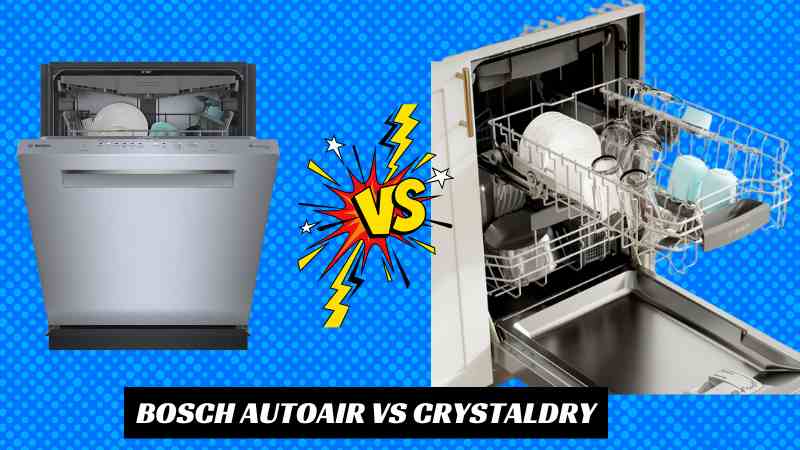
You want to buy a new dishwasher. You need to know Bosch Autoair (500 series) vs Brystaldry (800 series). You are in the right place. Let me tell you the real difference between them.
Bosch AutoAir
The Bosch AutoAir is a smart dishwasher. It has smart features like automatically cracking open my dishwasher door. The door opens at the end of the washing cycle. It releases all the steam and moisture trapped in the washing machine. Then circulate the new fresh air from the environment. When the dishwasher leaves the door open, all my dishes dry so much faster. One thing I notice the door does not open until the interior temperature is human-friendly. So, I never see any hot steam coming out of the dishwasher. It makes my family safe.
The AutoAir dishwasher’s working method is very simple. Also, it is very easy to use. I do not have to use minerals or chemicals to do the best dry. The dishwasher does not allow the water droplets to settle back onto my dishes. It always gives steam to dry the water droplets as fast as possible. The AutoAir can dry 30% faster than regular condensation drying.
The AutoAir features are available on Bosch’s 500 Series dishwashers. The 500 Series is especially a better option for middle-income families. You do not have to spend a huge amount of money to buy it, and you are getting premium features like AutoAir.
What I Like
- Energy efficient: The AutoAir consumes less electricity than other normal heating elements. It reduces my electricity bills.
- Simple, reliable technology: I find it very easy to use. It has no complex system to run the dishwasher.
- Great for glasses and ceramics: Every time I wash my plates, bowls, and glassware using my AutoAir. I find it leaves my dishes spot-free and perfectly dry.
- Perfect for overnight cycles: I run my dishwasher and keep the AutoAir enabled. I see my dishes beautifully dry in the morning. After the washing cycle ends, the dishwasher prevents water from pooling.
- Cost-effective upgrade: The Bosch AutoAir 500 series saves up to 200-300 dollars compared to the higher CrystalDry 800 series.
What Could Be Better
- Struggles with plastics: Plastic containers, sippy cups, and Tupperware don’t hold heat the way ceramics do. So they are more likely to come out with water pooling.
- Works best with rinse aid: Sometimes I need to use JetDry for a significantly cleaner result.
Bosch CrystalDry
The Bosch CrystalDry of the 800 Series is one of the best features of the Bosch brand. When I bought it from Amazon. I was super excited about experiencing the CrystallDry features. After using the dishwasher, I just love it. The CrystallDry does not open the door like AutoAir. It uses naturally occurring minerals. The minerals are called zeolite beads. It absorbs the moisture from the air inside my dishwasher. When the minerals absorb water. The dishwasher generates heat up to 176 degrees Fahrenheit. That heat is then blown back into the dishwasher chamber by fans. This powerful cycle method removes the moisture from dishes.
It does not matter whether I open the dishwasher door immediately or I leave my dishes in the dishwasher for hours and hours, I will still get my dishes dry. For better performance, I use Rise Agent. Also, CrystalDry works exceptionally well in soft or moderately hard water. If I have to rate the CrystalDry dishwasher, I will give 4.6 out of 5 stars.
What I Like
- Exceptional plastic drying: Even though AutoAir does not work best on plastics. But CrystalDry can completely dry sippy cups, plastic plates, and Tupperware.
- No door required: The door stays closed and gets perfect drying.
- Lifetime durability: The zeolite minerals never need replacing. The chemical lasts for the entire life of the dishwasher.
- Unbelievably quiet operation: At 42 decibels, the 800 Series with CrystalDry is whisper-quiet.
- Spot-free glasses and glassware: my glasses come out crystal clear with no water spots.
- 60% better drying than standard models: The complete evaporation is noticeably superior.
What Could Be Better
- Higher upfront cost: The 800 Series runs $1,299-$1,499, which is a slightly higher price tag than the 500 Series ($999-$1,199).
- Can run warmer: The CrystalDry generates noticeably more heat inside the chamber. If you have to dry any sensitive items that are harmful to warm air, you should avoid drying them.
- Requires proper water chemistry: CrystalDry performs best with soft water and a quality rinse agent. It also works well in hard water, but the results may be slightly less.
Bosch AutoAir vs CrystalDry
I’m lucky to use both AutoAir and CrystalDry. Let me compare their key differences:
Drying Performance:
| Drying Performance | AutoAir | CrystalDry |
|---|---|---|
| Better drying results | 40% better than standard | 60% better than standard |
| Dries plastics well | Sometimes wet | Completely dry |
| Works overnight | Yes | Yes |
| Water spot free | With rinse aid | With rinse aid |
| Time to fully dry | 7+ hours | 2-3 hours |
Winner: CrystalDry. If dry plastics matter to you, CrystalDry wins. AutoAir handles glasses well, but CrystalDry gets everything dry faster.
How the Door Behaves:
| Door Behavior | AutoAir | CrystalDry |
|---|---|---|
| Door opens at end | Yes, automatically | No, stays closed |
| Need to open manually | No | No |
| Steam escapes | Yes | No |
| Moisture re-settles | Possible | No |
| Cabinet safe | Yes | Yes |
Winner: CrystalDry. The CrystalDry is closed-door, so there is zero chance of moisture sneaking back. It keeps everything dry inside the machine.
Energy Use:
| Energy Efficiency | AutoAir | CrystalDry |
|---|---|---|
| Uses extra heat | No | No |
| Annual kWh | ~240 kWh | ~239 kWh |
| Energy Star rated | Yes | Yes |
| Monthly cost | ~$2.50 | ~$2.50 |
| Eco-friendly | Very | Very |
Winner: Tie. Both use almost identical energy. AutoAir saves money because no fan runs. CrystalDry saves money because no heater needed. Your electric bill stays the same either way.
Noise Level:
| Noise Level | AutoAir | CrystalDry |
|---|---|---|
| Decibels (dBA) | 44-46 dBA | 38-42 dBA |
| Quiet enough | Yes | Much quieter |
| Door opening sound | Slight pop | No door sound |
| Can hear during dinner | Maybe | No |
| Kid-friendly at night | Yes | Yes |
Winner: CrystalDry. Both are quiet. CrystalDry is quieter because no door pops open.
Warranty and Durability:
| Durability | AutoAir | CrystalDry |
|---|---|---|
| Dishwasher life | 10-15 years | 10-15 years |
| System replacement | Never needed | Never needed |
| Mineral refill needed | No | No |
| Bosch quality | Premium | Premium |
| Warranty years | Standard Bosch | Standard Bosch |
Winner: Tie. Both last forever. AutoAir has no moving parts except the door hinge. CrystalDry minerals never need replacement.
Water Type:
| Water Compatibility | AutoAir | CrystalDry |
|---|---|---|
| Works in soft water | Yes | Yes |
| Works in hard water | Yes, with rinse aid | Yes, with rinse aid |
| Mineral buildup risk | Low | Low |
| Needs water softener | No | No |
| Rinse aid necessary | Helpful | Helpful |
Winner: CrystalDry. Hard water affects both equally, but CrystalDry’s heat actually helps break down minerals slightly. Use rinse aid with either one. If you have extremely hard water, CrystalDry gives slightly better protection.
Price:
| Cost & Value | AutoAir | CrystalDry |
|---|---|---|
| Starting price | $999-$1,199 | $1,299-$1,499 |
| Price difference | Base model | ~$300-400 more |
| Value per dollar | Excellent | Great |
| Resale value | Good | Better |
| Worth the upgrade | For some | For families |
Winner: AutoAir (for budget). CrystalDry wins on performance, but AutoAir wins on wallet. The gap is $300-400.
Maintenance:
| Care & Upkeep | AutoAir | CrystalDry |
|---|---|---|
| Filter cleaning | Regular | Regular |
| Special parts to replace | No | No |
| Mineral refills | No | No |
| Door hinge maintenance | Maybe check | No door part |
| Cleaning inside | Monthly vinegar | Monthly vinegar |
Winner: CrystalDry. CrystalDry needs no door maintenance. AutoAir’s door hinge occasionally needs checking if it sticks.
Loading Flexibility:
| What You Can Load | AutoAir | CrystalDry |
|---|---|---|
| Plastics | Yes, but damp | Yes, completely dry |
| Glasses | Yes, dry | Yes, very dry |
| Pots and pans | Yes | Yes |
| Sippy cups | Slightly wet | Bone dry |
| Mixed loads | Good | Excellent |
Winner: CrystalDry. In CrystalDry’s heat, you can throw any mix of items in and they all come out truly dry.
FAQ
Is Bosch AutoAir vs CrystalDry a big difference?
Yes, the difference is real. AutoAir opens the door to let in fresh air. CrystalDry uses heat and minerals to dry dishes faster.
Which is better in Bosch AutoAir vs CrystalDry for plastic dishes?
CrystalDry dries plastic much better. AutoAir may leave some drops on cups and lids.
Is Bosch AutoAir vs CrystalDry worth the price jump?
AutoAir is kinder on your budget. CrystalDry costs more but saves time and effort.
Which is quieter in Bosch AutoAir vs CrystalDry models?
Both are quiet, but CrystalDry models are softer to the ear. You can run them at night with no stress. Learn more if low noise is key for you.
Bosch AutoAir vs CrystalDry which is better for families?
For small homes, AutoAir is often enough. For busy families with plastic dishes, CrystalDry wins.