

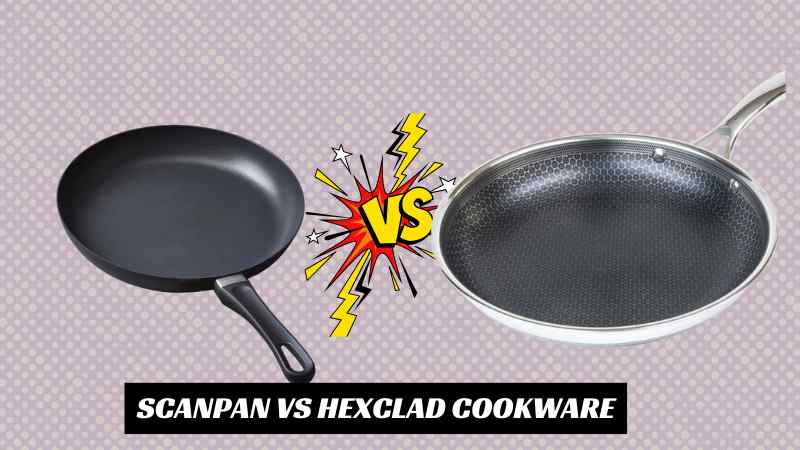
Do you want to choose the best pan between ScanPan and HexClad for your kitchen? This article is for you.
Scan Pan: The Best for Easy Cooking. This pan is light. Food does not stick to it. It is great for eggs and fish. It stays smooth for a long time. Get this if you want a pan that just works. Check Price On Amazon
Hex Clad: The Best for High Heat. This pan is strong. It can take a lot of heat. You can use metal tools on it. It works well in the oven too. Get this if you want a tough pan that is easy to clean. Check Price On Amazon
ScanPan vs HexClad Cookware
I tested both ScanPan and HexClad with the same ingredients, same recipes, and same heat levels. Here are the results I found:
Non-Stick Performance:
| Performance Area | ScanPan CTX | HexClad Hybrid |
|---|---|---|
| Surface Build | Smooth, continuous Stratanium | Raised steel peaks with recessed non-stick valleys |
| Day 1 eggs (no oil) | Slides freely across the pan | Sticks to the raised steel ridges |
| Pancakes without oil | Flips clean with no sticking | Catches easily; requires light fat |
| Fish (delicate foods) | Zero sticking; skin lifts clean | Tears skin unless oil or butter is used |
| Oil-Free Cooking | 100% oil-free capable | Not possible without food catching |
| Risk of Sticking / Burning | Very low on low-to-medium heat | High if heat is too high or cooking dry |
| After 3 months use | Still excellent glide | Still good with cooking oil |
| After 6 months use | Very smooth release | Noticeably weaker non-stick release |
| Breakfast Readiness | Instant, zero learning curve | Requires preheating and cooking fat |
Winner: Scanpan CTX wins for effortless, pure non-stick glide with zero oil. HexClad Hybrid wins only if you plan to cook with butter or oil and want the added bite of steel peaks.
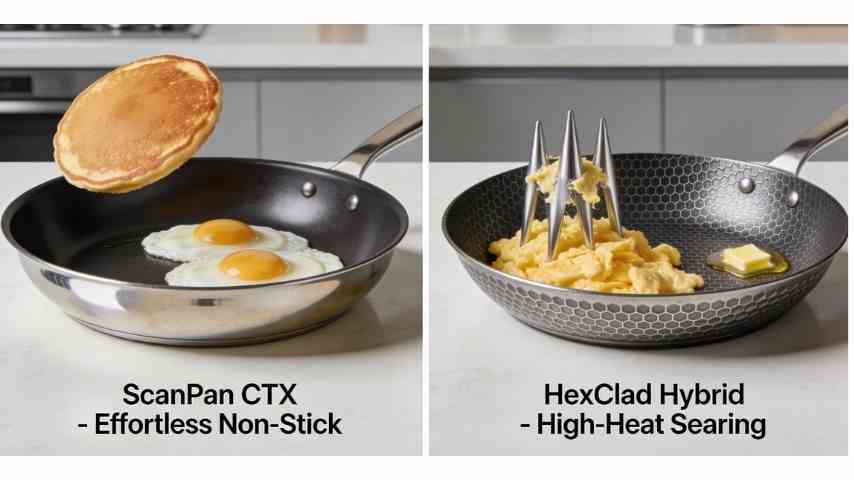
Many beginner chefs ask me if HexClad is a real non-stick pan. My quick answer is no. HexClad is a hybrid pan with high steel peaks and low non-stick spots. I saw my food hit bare steel, so eggs can catch and stick in the cookware.
After I owned ScanPan and HexClad, I cracked an egg into both dry pans to test them. In the Scanpan CTX, the egg slid fast like a puck on cold ice. In the HexClad, the egg stuck right to the steel ridges and tore. I had to add a drop of oil to lift it clean.
I have cooked fish on both cookers as well. I saw the same thing. My Scanpan lets soft fish lift with no oil at all. With HexClad, I must keep heat low and use butter. If the pan gets too hot, I saw my food stick and burn.
After six months of daily use, the differentiation gap between these two cookware brands grew even more clear. My Scanpan still wipes clean in ten seconds with warm water. On the other hand, my HexClad non-stick spots lost some of their slick glide. It still cooks well because it’s made of steel.
My Advice: If you want to make food fast, like making eggs with zero oil, buy the ScanPan CTX. It works like a charm. Pick HexClad only if you like to cook with oil.
Searing Power:
| Searing Task | ScanPan CTX | HexClad Hybrid |
| Steak browning | Good, even browning | Deep, golden-brown crust |
| Chicken thigh crust | Decent color; soft skin | Crisp, restaurant-style crunch |
| Fond development (flavor bits) | Very light; food slides away | Rich, dark bits for pan sauces |
| Heat retention | Good, steady heat | Excellent, stays hot under cold meat |
| Crust depth | Medium surface browning | Deep, steakhouse-grade sear |
| Pan recovery speed | Moderate | Fast rebound after adding food |
| Cast Iron Comparison | Slower crust; no sticky fond | Near cast-iron crust without the heavy weight |
Winner: HexClad Hybrid wins by a mile for deep searing, crisp crusts, and rich pan sauces. Scanpan CTX wins if you want gentle browning on delicate foods without meat sticking.

When I have to talk about high heat and steak, HexClad takes the crown. The raised steel peaks grab onto the meat with a firm grip. This creates a deep, dark crust just like a cast iron pan. Best of all, you do not have to lift a heavy ten-pound skillet.
I put a thick steak into both hot pans to see the sear. The Scanpan CTX browned the meat, but the crust was pale and thin. In the HexClad, the meat sizzled loud and got a crisp golden edge fast. Cold meat did not cool the pan down at all.
The biggest win for HexClad is the rich fond left in the pan. Fond is the name for those tasty brown bits stuck to the base. With Scanpan, food slides so much that no brown bits can form. With HexClad, I poured in some broth and made a rich pan sauce in two minutes.
Cooking chicken thighs showed me the same thing. The HexClad gave the skin a crisp crunch that tasted so good. My Scanpan cooked the meat fine, but the skin was soft. If you want a real steak crust at home, pick HexClad.
Heat Performance:
| Heat Factor | ScanPan CTX | HexClad Hybrid |
| Heat-up time (low to medium) | 2–3 minutes | 1–2 minutes |
| Heat-up time (high heat) | 3–4 minutes | 2–3 minutes |
| Even heat distribution | Excellent, rim-to-rim | Excellent, rim-to-rim |
| Hotspots | None observed | None observed |
| Thermal mass | Moderate (5-ply build) | High (dense steel grid) |
| Temperature responsiveness | Steady and gentle | Fast and snappy |
| Cooktop compatibility | Gas, electric, ceramic, induction | Gas, electric, ceramic, induction |
| Induction stove note | 5-ply steel core works on all | Full magnetic steel works on all |
Winner: HexClad Hybrid wins for rapid heating and snappy temperature control on busy nights. Scanpan CTX wins for gentle, steady warmth that protects delicate food from burning.
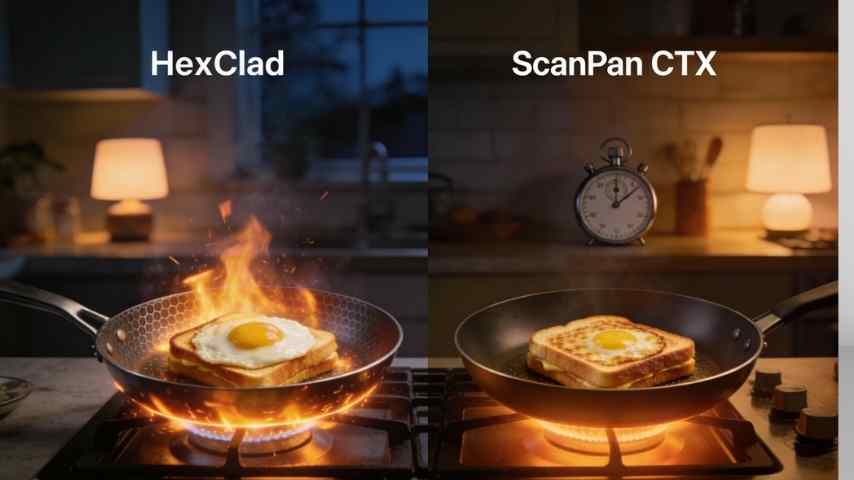
When I get home tired from work, every minute counts. HexClad heats up fast, getting hot in just one to two minutes. Scanpan CTX takes about three minutes to reach that same warmth. If you want to cook in a flash, HexClad wins on pure speed.
Both pans spread heat from rim to rim with zero hot spots. I saw no burnt rings or cold zones when frying big pancakes. HexClad has more steel mass, so it reacts quick when you turn the knob. Scanpan warms up with a steady pace that keeps you from burning food.
Do you cook on induction? Both pans work on it with no fuss. HexClad has a full steel base that clicks on fast. Scanpan CTX works on induction too, but old plain Scanpan pans will not.
For fast weekday cooking, HexClad gives you great snap and speed. It gets hot fast and holds heat well when you add cold food. Scanpan CTX is best if you want slow, calm heat for delicate meals. Both pans spread warmth with ease, so pick the speed you love.
Durability Over Time:
| Durability Measure | ScanPan CTX | HexClad Hybrid |
| Visible wear at 3 months | Minimal, looks brand new | Minimal, looks brand new |
| Visible wear at 6 months | Minimal, smooth surface | Slight scuffing on steel ridges |
| Non-stick release at 1 year | Very strong; eggs still slide | Noticeably weaker; needs more oil |
| Main cause of coating wear | High heat or aerosol spray | Burnt oil buildup in valleys |
| User reports of peeling | Extremely rare | Reported by some users over time |
| Expected non-stick life | 2–3 years with good care | 1–2 years before sticking begins |
| Pan body durability | 5–10 years (heavy-duty) | 10+ years (rock-solid steel) |
Winner: Scanpan CTX wins for long-lasting non-stick release that stays slick over years of use. HexClad Hybrid wins for a tough steel shell that resists dents, dings, and warps.
For the first three months, both pans looked brand new. Eggs slid with ease, and wash time was a quick breeze. Around month six, small changes began to show on the stove. My Scanpan stayed slick, while food caught on the HexClad peaks.
Why does HexClad lose its slick feel over time? Tiny drops of cooking oil get trapped in the low valleys. High heat bakes that oil into a dark, sticky film. Once that film forms, eggs will stick to the base like glue.
Scanpan has a smooth face, so oil cannot hide in cracks. It lasts two to three years if you treat it with care. Just keep heat low and skip fake oil spray from a can. Aerosol spray leaves a baked gum that kills the slick coat.
The steel body of HexClad will last for ten long years. Yet its non-stick release often fades after just one or two years. Scanpan CTX costs good cash, but its slick coat holds up best. If you want a pan that glides year after year, pick Scanpan.
Metal Utensil Safety:
| Metal Utensil | ScanPan CTX | HexClad Hybrid |
| Flat metal spatula | Wood or silicone recommended | Yes, fully safe to use |
| Metal whisk | Not recommended | Yes, fully safe to use |
| Metal spoons & tongs | Wood or silicone recommended | Yes, safe for daily stirring |
| Sharp forks or knives | No, will scratch the surface | Avoid; points can gouge valleys |
| True scratch-proof rating | Not scratch-proof | Scratch-resistant, but not 100% proof |
| Cook stress level | Higher; must use soft tools | Low; flip and stir with common metal tools |
Winner: HexClad Hybrid wins for easy metal tool freedom at the stove. Scanpan CTX wins if you do not mind using wood or silicone spoons to protect a smooth, pure non-stick pan.
Cooking with any tool in your drawer feels great. You do not want to hunt for a wood spoon when eggs are on the stove. HexClad shines here because raised steel peaks act like a shield. Flat metal spatulas slide right over the top with no harm.
Still, is HexClad truly scratch proof? The real answer is no, not if you use sharp tools. Fork tines or knife tips can poke deep into the low valleys. If a sharp point hits that low spot, the black coat will scratch.
Scanpan asks you to show a bit more care. The base is strong, but metal spoons can leave fine gray lines. I stick to wood or soft rubber tools when I cook with it. That simple step keeps the slick face looking fresh for years.
If you hate babying your pans, HexClad brings great peace of mind. You can flip, scrape, and stir with common metal spoons all day long. Just keep sharp knives and forks away from both brands. Pick HexClad for tough steel, or pick Scanpan for gentle glide.
Weight and Handling:
| Weight Factor | ScanPan CTX | HexClad Hybrid |
| 10-inch frypan weight | ~2.5 lbs (light and nimble) | ~3.5 lbs (heavy and solid) |
| 12-inch frypan & chef pan | ~3.2 lbs; easy one-hand lift | ~4.5 lbs; needs a helper handle |
| One-handed tossing | Easy, smooth, and natural | Requires good wrist and arm strength |
| Wrist fatigue after 20 min | Minimal wrist strain | Noticeable forearm fatigue |
| Balance across cookware line | Even balance from saucepans to pots | Front-heavy on larger skillets |
| Best for smaller hands | Ideal for light, quick moves | Best if you like thick, heavy pans |
Winner: Scanpan CTX wins for light, nimble handling that saves your wrist from aches. HexClad Hybrid wins if you love a heavy, solid pan that sits rock-still on the burner.
When you stand at the stove for thirty minutes, pan weight matters a lot. A ten-inch Scanpan weighs around two and a half pounds. The same size HexClad weighs about three and a half pounds. That one extra pound feels huge when your wrist gets tired.
I love to toss diced greens in the air with one hand. With Scanpan, my wrist flicks with ease and feels light as air. With HexClad, tossing food asks for real grip and arm strength. I had to use both hands just to slide it into a hot oven.
The gap grows even bigger with twelve-inch pans and big pots. A large HexClad chef pan gets close to five pounds with food inside. You must grab the helper handle on the side to move it. Scanpan stays balanced and light from small saucepans to big stock pots.
If you have small hands or weak wrists, Scanpan is a joy to hold. Your arms will not ache after cooking a big meal. Pick HexClad if you love a heavy pan that sits rock still. For easy daily meals, the lighter pan is best for your wrists.
Cleaning:
| Cleaning Factor | ScanPan CTX | HexClad Hybrid |
| Water and sponge only | Yes, always rinses clean | Often needs firm scrubbing |
| Average cleanup time | ~30 seconds | 1–2 minutes |
| Stuck-on or burnt food | Soft soak lifts it right off | Needs a firm sponge or baking soda |
| Dishwasher safe | Yes, but hand wash is best | Yes, but hand wash is best |
| How to restore burnt food | Simmer warm water; no abrasive pads | Scrub steel peaks with a firm pad |
| Water marks and smudges | Dark brushed steel hides spots | Shiny stainless rims show water spots |
Winner: Scanpan CTX wins for effortless 30-second cleanup with just a soft sponge. HexClad Hybrid wins if you want a pan that can take firm scrubbing when food burns.
Facing a sink full of pots after a meal is no fun. This is where Scanpan CTX feels like pure magic. A quick warm rinse and a soft sponge wipe make it look brand new. It takes me just thirty seconds, and I am back on the couch.
HexClad takes more elbow grease at the sink. The tiny grooves around the steel peaks love to trap brown bits. You cannot just wipe it with a soft cloth and walk away. You must scrub with a firm sponge to clear out those low spots.
What do you do if food burns to the base? On HexClad, you can scrub the steel peaks with a firm pad. On Scanpan, never use hard scrub pads or rough powder. Just boil warm water in the pan, and the burnt bits lift right off.
Both pans can go in the machine, but hand wash is best. The dark brushed steel on Scanpan hides dry water marks well. HexClad has bright steel rims that show every single spot. If you want fast, easy clean time, Scanpan is the big win
Price and Real Value:
| Price Factor | ScanPan CTX | HexClad Hybrid |
| 10-inch pan price (current) | $149–$160 | $220–$250 |
| Price difference | Baseline price | $70–$90 more expensive |
| Expected lifespan | 2–3 years | 1–2 years |
| Cost per year (3-year run) | $50–$53/year | $73–$83/year (up to $110/yr) |
| Warranty coverage | Limited lifetime | Limited lifetime |
| Warranty claims honored | Generally yes; smooth support | Often disputed by support |
| Bundle pricing available | Yes (smaller core sets) | Yes (large sets cut cost per piece) |
| Sales & promo discounts | Frequent 20% to 40% off sales | Rare discounts on single pans |
| Global store availability | US, Canada, UK, Australia, NZ shops | Mostly online direct and Costco |
Winner: Scanpan CTX wins for lower upfront price, better yearly value, and great seasonal sales. HexClad Hybrid wins on bundle set value if you plan to buy a large multi-piece box.
The price tag on both pans shows a big gap right away. A ten-inch Scanpan costs about one hundred and fifty bucks. The same size HexClad costs near two hundred and thirty. That leaves eighty bucks in your pocket on day one.
How often do these pans go on sale? Scanpan runs big sales in the US, Canada, and Australia all year long. You can find coupon codes for twenty to forty percent off in big shops. HexClad sells straight from its site and rarely cuts price on a single pan.
Now let us break down the real cost over time. Scanpan lasts about three years, costing fifty bucks a year to own. HexClad costs close to one hundred dollars each year. Scanpan also helps you fast if a pan goes bad.
HexClad sets cost less if you buy three pans at once. Yet for one pan, Scanpan saves you real cash right away. You get top food on the stove with no hype. If you want the best deal for your cash, pick Scanpan.
Safety Certifications:
| Safety Measure | ScanPan CTX | HexClad Hybrid |
| 100% PFOA & PFOS-Free | Yes, clean since 2006 | Yes, clean of PFOA and PFOS |
| Does it contain PTFE? | Yes (in the Stratanium topcoat) | Yes (in recessed non-stick valleys) |
| Is it 100% PFAS-Free? | No; PTFE belongs to PFAS family | No; settled 2024 advertising lawsuit |
| Core pan materials | Recycled cast aluminum & titanium | Tri-ply stainless steel & aluminum core |
| Made under strict EU laws | Yes, made in Denmark | No, produced in China |
| Food-safe below 500°F (260°C) | Yes, completely stable and inert | Yes, completely stable and inert |
Winner: Scanpan CTX wins for long-term safety honesty and strict Danish factory oversight. HexClad Hybrid wins for safe, food-grade steel bonding as long as you keep your heat under 500°F.
Are these pans safe for you and your kin? The truth about what is in the pan matters most. Both Scanpan and HexClad are free of bad old PFOA. Yet both brands still use PTFE to make food slide.
Does HexClad use Teflon in its pan? The plain answer is yes. HexClad puts real PTFE in the low spots between the steel peaks. They lost a big case for saying their pans had no bad stuff.
What is Scanpan made of inside? They use melted aluminum fused with hard rock. Then they seal it with a tough non-stick coat on top. Danes make each pan under strict laws for safe home meals.
Both pans are safe to use if you keep heat down. Never let your pan sit dry on high flame past five hundred degrees. Scanpan wins my trust because they tell the truth about what is inside. If you want clear facts and safe food, pick Scanpan.
Oven Safety:
| Oven Factor | ScanPan CTX | HexClad Hybrid |
| Maximum pan oven temp | 500°F (260°C) | 500°F (260°C) |
| Glass lid heat limit | 500°F (fully oven-safe) | 400°F (tempered glass limit) |
| Broiler safe? | No; direct flame scorches coating | Yes, safe up to 500°F |
| Handle grip with oven mitts | Excellent; flat groove prevents spin | Round shape can slip or twist |
| Handle heat on stovetop | Stays cool to the touch | Gets warm near the pan base |
| Confidence moving hot pans | High, steady balance | Requires two hands and care |
Winner: HexClad Hybrid wins for broiler safety at high heat. Scanpan CTX wins for a cooler, firmer handle grip and high-heat glass lids up to 500°F.
Moving a hot pan from stove to oven is a common step. Both pans take high oven heat with no fear. They can bake up to five hundred degrees with ease. Yet lifting them with hot mitts feels very different.
Scanpan uses a flat handle with a smart groove on top. Even with thick mitts on, the pan will not twist in your grip. The HexClad handle is round and smooth like a pipe. When the heavy pan is full of hot fat, it can spin if you are not careful.
Watch out for the glass lids. Scanpan lids take full heat just like the pan. HexClad glass lids must not pass four hundred degrees. Yet HexClad can go under a top flame, but Scanpan can not.
If you want to melt cheese under a hot broiler, HexClad wins that race. For all other oven bakes, Scanpan feels much safer in your hand. The handle stays cool and gives you great peace of mind. Pick the pan that makes you feel safe when the heat is high.
Brand Reputation:
| Brand Factor | ScanPan | HexClad |
| Years in business | 70 years (crafting pans since 1956) | 10 years (founded in 2016) |
| Manufacturing origin | Made in Ryomgård, Denmark | Designed in US, made in China |
| Celebrity promoter | None; trusted by culinary academies | Gordon Ramsay (paid equity partner) |
| Eco-friendly build | 100% recycled cast aluminum | Standard multi-clad manufacturing |
| Customer service reputation | High trust; prompt, helpful support | Mixed user reviews on warranty claims |
| Core brand reputation | Quiet craftsmanship and culinary heritage | Massive social media hype and TV ads |
Winner: Scanpan wins for 70 years of quiet Danish craftsmanship, green materials, and trusted chef heritage. HexClad wins for massive star power with Gordon Ramsay and bold modern marketing.
Who you buy from matters just as much as the pan. Scanpan has made pans in Denmark for seventy years. That is a long track record with real home cooks. HexClad is a new brand that is just ten years old.
You have seen Gordon Ramsay praise HexClad on your TV screen. Keep in mind that he owns a big piece of that brand. He gets paid well to tell you those pans are the best. It is smart marketing, but you must look past the star hype.
Scanpan takes a quiet path with no star ads. Pro cooks use these pans in great cooking schools across the globe. They use clean scrap metal to make green pans for the earth. Their crew is quick to help if you ever have a problem.
When you spend two hundred bucks, trust is king. Scanpan has proven its pans for seventy years with no fuss. HexClad brings big flash, but Scanpan brings true peace of mind. If you want good pans that will last, pick Scanpan.
My Personal Cooking Experience
I spent eight weeks testing both pans side by side in real kitchens, cooking the meals people actually make on weeknights. This wasn’t lab testing—this was scrambled eggs, weeknight stir-fries, and Sunday roasts.
During my first week with the Scanpan CTX, I made scrambled eggs without using any butter at all. The eggs slid off the pan like they were on ice. The lightweight handle felt perfect in my hand. Cleanup was instant, as I just gave it a quick rinse and was done. The pan felt luxurious but did not make me nervous about breaking it. I felt confident cooking delicate things immediately. Then I tested searing chicken at high heat. The pan handled it fine, but the crust was not as dramatic as I expected. The lighter weight means there is less thermal mass, so browning happens slower. It still cooked beautifully, just without that dark look professional cooks chase.

During the next week with Hexclad, the first thing I noticed was that the pan has real weight. You can really feel it in your hand. The hexagon pattern is beautiful but raises questions about if it will even be non-stick. I made the same egg test and they stuck a little bit. It was not a big mess, but it was enough to make me think about the cost. Then I preheated the pan longer and used a tiny bit of oil. I got perfect slides after that. When I seared those same chicken pieces at high heat, something clicked. The stainless steel peaks gripped the meat differently. The browning was deeper and richer. The flavor bits were more developed. This is what professional cooking looks like.
The real difference is that Scanpan felt like luxury non-stick that wanted me to be gentle. Hexclad felt like stainless steel wearing non-stick shoes because it wanted me to push it harder. Neither is wrong as they just answer different questions.
Why Choose ScanPan
- Easy to use. Food slides off for a long time. It works like new for many weeks.
- Light weight. It is light in your hand. You can flip food with one wrist.
- Safe build. It is made in Denmark. It meets high safety rules.
- Use metal tools. Metal spoons will not hurt it. The surface is very tough.
- Good for Earth. It uses old metal to make new pans. This helps the planet.
- Great help. The team fixes bugs fast. They help you if you have a problem.
- Hot oven safe. It can go in a hot oven. The handle stays cool on the stove.
ScanPan Downsides
- Slow to brown. It does not get meat very brown. High heat is not its best skill.
- Wears out. The coat will fade after two years. No non-stick lasts forever.
- High cost. It costs a lot of money. Since it wears out, the price feels high.
- No lid. You do not get a lid with the pan. You must buy one on your own.
Why Choose HexClad
- Good crust. It browns meat well. It works like a pro pan for a nice sear.
- Metal tools. Use any tool you want. Metal forks and spoons are fine.
- Smart mix. It uses steel peaks and low spots. This helps cook and clean.
- Strong build. It stays tough for a long time. It does not scratch in a big way.
- All stoves. It works on gas or electric. It also works on induction.
- Oven safe. You can put it in a hot oven. This helps finish your meal.
HexClad Downsides
- Hard to learn. Eggs might stick at first. You must use oil and heat it well.
- Heavy pan. It is heavy to lift. Your wrist might feel tired after use.
- Stick risk. Soft foods like fish can stick. You must be very careful.
- Coat fades. Some say the coat fails fast. This may happen in less than a year.
- Law suit. They paid cash to settle a court case. Some felt the ads were not true.
- Made in China. It is not made in Europe. Some like other rules for builds.
FAQ:
Q: Is Scanpan vs Hexclad worth the investment?
A: Both brands make very good pans that feel solid. Scanpan is a great pick if you want a pan that is easy to use every single day. Hexclad is a better pick if you want to brown meat like a pro. Most pans from both lines cost between $150 and $250. You should pick based on how you like to cook rather than just the name on the box.
Q: Which has truly non-stick right out of the box?
A: Scanpan wins this round. You can cook eggs in it with no oil at all, and they will slide right out. Hexclad has a mix of steel and non-stick surfaces. Because of this, you must use a little oil or butter when you cook eggs. If you want the slickest surface possible, Scanpan is the best choice for you.
Q: How long will my pan really last?
A: A Scanpan will usually stay in good shape for 2 to 3 years if you use it every day. Hexclad tends to lose its non-stick power after 1 to 2 years of hard use. Both brands say they have a lifetime promise. However, Scanpan is often better at helping customers who have a problem with their pan.
Q: Can I use metal spoons and forks?
A: You should not use metal tools on a Scanpan. While the top layer is very strong, wood or plastic tools will help it last much longer. Hexclad is built to handle metal. You can use any spoons or forks you want without fear. If you hate having to pick a specific tool, Hexclad is a nice choice.
Q: Which sears meat better?
A: Hexclad wins here by a mile. It has small steel peaks that grab the meat. This creates a crust that looks and tastes like it came from a steak house. Scanpan can brown meat, but it will not give you that deep, dark crunch that most cooks love.
Q: Is warranty protection important?
A: Yes, it is very vital. Scanpan usually says yes to help fix or swap a broken pan. Hexclad can be much harder to work with, and they often say no to claims. This is good to know if you plan to keep the pan for a long time and want peace of mind.
Q: Which is lighter and easier to use?
A: Scanpan is the lighter of the two. A 10-inch pan weighs about 2.5 pounds, while Hexclad weighs 3.5 pounds. If you cook for 20 minutes, your wrist might start to feel tired with the heavier pan. Scanpan is much easier to lift and move around the stove.
Q: Do these pans stain or show water marks?
A: Scanpan has a dark, flat finish on the outside. This hides spots and water marks very well. Hexclad has a shiny steel outside. It shows every fingerprint and water drop. If you want a pan that looks clean without a lot of scrubbing, Scanpan is the way to go.
Q: Are they safe for family cooking?
A: Yes, both pans are safe for your home. The FDA says the materials they use are fine for food. Scanpan uses a coating called PTFE. Hexclad now uses a ceramic layer. Neither pan will hurt you or your family when you use them the right way to make a meal.
Q: Which should I buy if I can only get one pan?
A: Buy Scanpan if you want a pan that is easy to clean and very slick. Buy Hexclad if you are a serious cook who wants to sear meat and use metal tools. For most people, Scanpan does 80% of the work in the kitchen with no fuss at all.
Leave a Reply