

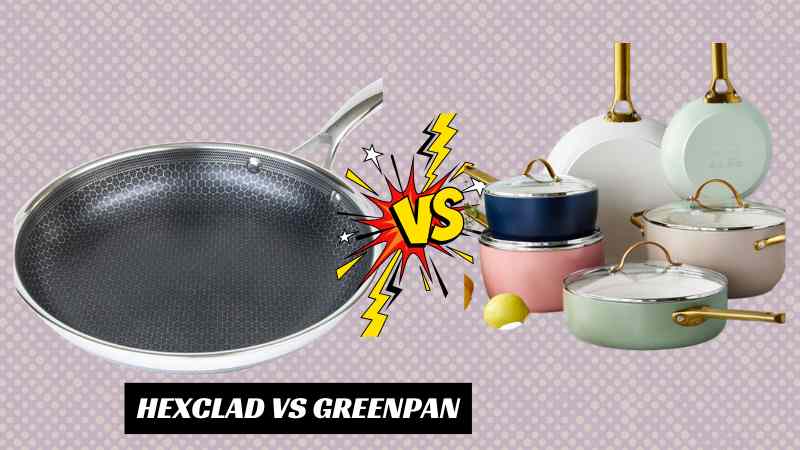
Do you want new pans? You may see Between HexClad and GreenPan. It’s time to help you to get the right Cookware.
HexClad Hybrid: Best for High-Heat Searing & Heavy Use
HexClad is built like a tank and handles high heat with ease. It sears steak, chicken, and burgers with restaurant-quality browning. The raised stainless steel grid protects the non-stick surface so you can safely use metal spatulas and tongs. If you cook heavily every day and want a rugged pan that will last 5–7+ years, pick this one.
GreenPan Valencia Pro: Best for Quick Meals & Delicate Foods
Valencia Pro is the ultimate pan for morning eggs, pancakes, and delicate fish fillets. Food glides across the smooth Thermolon ceramic surface with little to no oil needed. It is lightweight, 100% PFAS-free, and easy on your wrists. If you want an effortless, healthy, low-cost pan for simple daily meals, pick this one.
GreenPan Spectra Hybrid: Best for Non-Toxic Durability & High Heat
GreenPan Spectra combines the health benefits of ceramic with the durability of a raised stainless steel grid. It handles oven temperatures up to 600°F and lets you get a crisp sear while keeping your kitchen PTFE- and PFAS-free. If you want the scratch resistance of a hybrid pan without traditional chemical coatings, buy this one.
GreenPan Apex Hybrid: Best for Premium Stainless Steel Cooking
GreenPan Apex delivers a heavy 3-ply clad stainless steel body paired with a protected ceramic grid. It offers superior heat retention across the base, resists scratches from metal utensils, and looks sleek on the stove. If you want the heft and browning power of stainless steel cookware with healthy ceramic food release, pick this one.
GreenPan Prism Hybrid: Best for Everyday Balance & Easy Cleanup
GreenPan Prism provides a balanced hybrid surface engineered for everyday meal prep. The geometric steel grid shields the non-stick valleys from wear and tear while releasing food faster and cleaning up easier than bare stainless steel. If you want a durable, scratch-resistant hybrid pan for family dinners, pick this one.
HexClad vs GreenPan Cookware
I have cooked with both HexClad and GreenPan Cookware. Here are the differences I found:
Non-Stick Performance Right Out of the Box
- Can you make eggs without sticking?
- Will fish release without breaking?
| Feature | HexClad Hybrid | GreenPan Pure Ceramic (Valencia Pro) |
GreenPan Hybrid (Spectra / Apex / Prism) |
Category Winner |
|---|---|---|---|---|
| Eggs with minimal oil | Good (requires fat/butter) | Excellent (slides with zero oil) | Very Good (minimal fat needed) | GreenPan Valencia Pro |
| Delicate fish fillets | Moderate (requires fat & temp control) | Excellent (effortless release) | Very Good (clean release) | GreenPan Valencia Pro |
| Metal utensil safety | Yes (steel peaks protect valleys) | No (scratches ceramic coating) | Yes (steel grid shields base) | Tie (HexClad & Spectra/Apex) |
| Searing capability | Excellent (steakhouse-grade sear) | Good (moderate browning) | Very Good (3-ply clad base) | HexClad Hybrid |
| First-day learning curve | Moderate (requires preheat & fat) | None (instant nonstick performance) | Low (intuitive surface) | GreenPan Valencia Pro |
Winner: GreenPan Valencia Pro (Pure Ceramic).
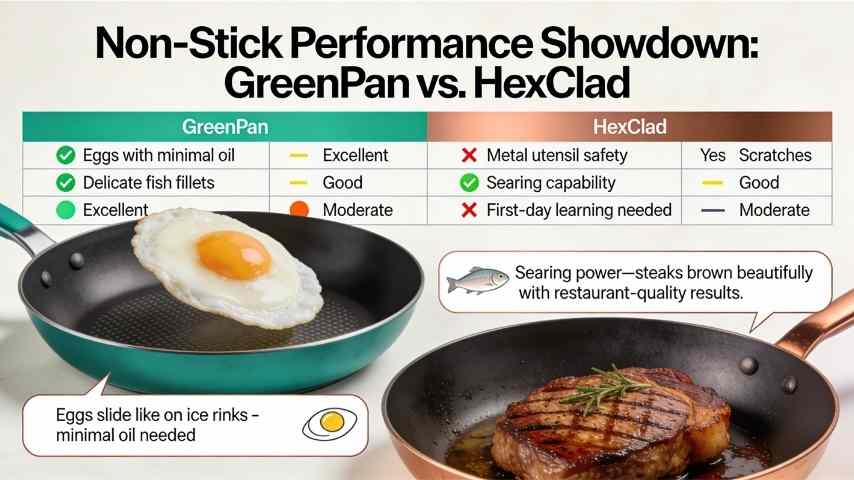
Cooking on day one feels very different depending on whether you choose pure ceramic, a PTFE hybrid, or a ceramic hybrid. When I first tried my GreenPan Valencia Pro, I cracked a fresh egg into the pan with almost no oil at all. To my surprise, the egg slid around easily just like it was on a smooth ice rink. This made flipping pancakes and searing thin fish fillets feel very simple because nothing stuck to the Thermolon ceramic surface. It is the exact dream that most home cooks have when they buy new tools.
However, my first day with HexClad Hybrid was a bit more of a learning curve. When I tried that same egg test without using any fat, the egg stuck to the small steel peaks on the surface. This felt a bit frustrating at first, but I soon found out that this pan expects you to cook more like a chef in a real restaurant. Once I added a little bit of oil and let it preheat properly, the magic started to happen. The pan showed off its true power by searing steaks until they were brown and making chicken skin very crispy.
If you are looking at GreenPan’s hybrid series—like the GreenPan Spectra, Apex, or Prism—they sit right in the middle of these two experiences. Their raised stainless steel grid gives you the metal-utensil safety and browning ability of HexClad, while the Thermolon ceramic base delivers a slightly slicker initial egg release with less oil.
While GreenPan Valencia Pro is the clear winner for someone who wants effortless eggs and delicate foods without added oil, HexClad Hybrid is the better pick if you want commercial-grade high heat and deep searing. If you want non-toxic ceramic peace of mind combined with metal utensil protection, GreenPan Spectra or Apex Hybrid serves as the ideal middle ground.
Durability After Six Months of Regular Use
- Will this still work in six months?
- How does the coating hold up?
| Durability Factor | HexClad Hybrid | GreenPan Pure Ceramic (Valencia Pro) |
GreenPan Hybrid (Spectra / Apex / Prism) |
Category Winner |
|---|---|---|---|---|
| Non-stick at 6 months | 85% of day-one performance | 65% of day-one performance | 75% of day-one performance | HexClad Hybrid |
| Metal utensil scratch resistance | Excellent (raised steel peaks) | Poor (scratches over time) | Very Good (steel grid protection) | HexClad Hybrid |
| Performance after 12 months | 80%+ | 50–60% | 65–70% | HexClad Hybrid |
| Expected lifespan | 5–7+ years | 2–3 years | 3–5 years | HexClad Hybrid |
| Coating holds up with daily use | Very strong (durable PTFE valleys) | Moderate (sol-gel ceramic wears) | Strong (protected ceramic) | HexClad Hybrid |
Check GreenPan Price On Amazon
The HexClad Hybrid pans use a smart design with raised stainless steel peaks that protect the non-stick valleys in between. When I used my metal spatulas and tongs, the utensils only made contact with the steel grid. The non-stick areas stayed completely safe underneath. After half a year of everyday cooking, eggs still slid right out with no trouble at all. It felt remarkably close to the first day I used it. Because it is built to last for five to seven years or even more, HexClad is a fantastic pick if you want a heavy-duty pan that stays strong through years of daily cooking.
Traditional ceramic pans like the GreenPan Valencia Pro tell a story that is a bit different. It relies on a smooth, flat Thermolon ceramic layer. At first, it is exceptionally slick. But after three months of regular use, I started to notice a change. By month six, I had to use noticeably more oil or butter to keep delicate foods from sticking. It felt like a favorite pair of jeans that gets thin after you wash them a lot—it did not chip or peel off in sheets, but the smooth factory slickness gradually faded. Most home cooks find they need to replace smooth ceramic pans every two to three years. It is a solid, clean pan, but it naturally has a shorter lifespan.
GreenPan’s hybrid lines—such as the GreenPan Spectra, Apex, and Prism—bridge this durability gap nicely. By embedding a stainless steel lattice over their Thermolon ceramic surface, they prevent metal utensils from gouging the nonstick layer, giving them a longer lifespan (3 to 5 years) than standard smooth ceramic pans. However, because sol-gel ceramic inherently loses its slickness faster than PTFE under repeated high-heat searing, the HexClad surface still retains its nonstick release significantly longer.
Overall, HexClad Hybrid remains the undisputed winner for long-term durability and rugged daily use, while GreenPan Spectra/Apex offers an upgraded, scratch-resistant alternative for cooks dedicated to staying 100% ceramic and PTFE-free.
Price Over Time
What’s the real cost when you factor in replacement?
| Cost & Longevity Factor | HexClad Hybrid | GreenPan Pure Ceramic (Valencia Pro) |
GreenPan Hybrid (Spectra / Apex / Prism) |
Category Winner |
|---|---|---|---|---|
| Single 10″ pan price today | $179.99–$209.99 | $60–$90 | $110–$140 | GreenPan Valencia Pro |
| Complete quality cookware set | $600–$800 (13-pc set) | $300–$400 (10–11-pc set) | $450–$600 (10-pc set) | GreenPan Valencia Pro |
| Expected nonstick lifespan | 5–7+ years | 2–3 years | 3–5 years | HexClad Hybrid |
| Replacement frequency | Every 5–7+ years | Every 2–3 years | Every 3–5 years | HexClad Hybrid |
| 7-year estimated pan cost | ~$210 (1 pan) | ~$240–$270 (3 pans) | ~$220–$280 (2 pans) | Tie (HexClad slightly better) |
Check GreenPan Price On Amazon
When you look at the price of new pans, the math can be quite fun to think about. If you buy a HexClad Hybrid pan today, you might pay around two hundred and ten dollars. A pure ceramic pan like the GreenPan Valencia Pro might cost you only seventy-five dollars, while a ceramic hybrid model like the GreenPan Spectra or Apex sits in the middle at roughly one hundred and twenty dollars.
At first glance, GreenPan looks like the clear pick for your wallet because the upfront entry price is significantly lower. But if you think about how long they last under real-world cooking, the story shifts.
A HexClad pan can stay in your kitchen for seven years or more without losing its structural integrity. A traditional smooth ceramic pan like the Valencia Pro often needs a swap after two or three years once the delicate sol-gel coating wears thin. Over seven years, you might buy three Valencia Pro pans to keep your cooking slick, which adds up to roughly $240 to $270. If you choose a hybrid like the GreenPan Spectra or Prism, you might only replace it twice over that same seven-year stretch, totaling around $220 to $280. By the end, the single HexClad purchase saves you a bit of cash and the hassle of repeated shopping trips.
Yet, there is more to it than just the math of the coins. Many people love getting a fresh GreenPan every few years. They enjoy picking out a new style or color for their stove, and they appreciate knowing they are cooking on 100% PFAS-free ceramic without spending a massive sum on day one. They do not want to deal with long customer service calls or complex warranties—they just want clean, easy pans.
For me, I like the idea of one heavy-duty pan that stays with me through all my meals for the long haul. But if you want a lower upfront investment and pure non-toxic ceramic peace of mind, GreenPan’s traditional lines are fantastic value today, while their Spectra/Apex hybrid lines provide a smart middle-tier balance.
Weight and Comfort During Cooking
Does your hand get tired? Can you flip easily?
| Comfort Factor | HexClad Hybrid | GreenPan Pure Ceramic (Valencia Pro) |
GreenPan Hybrid (Spectra / Apex / Prism) |
Category Winner |
|---|---|---|---|---|
| 10″ pan weight | 3.2 lbs | ~2.0 lbs | ~2.4–2.5 lbs | GreenPan Valencia Pro |
| Handle comfort | Good (stay-cool round steel) | Excellent (ergonomic, lightweight) | Very Good (cast stainless steel) | GreenPan Valencia Pro |
| Ease of flipping | Moderate (requires wrist strength) | Excellent (effortless wrist flick) | Very Good (balanced swing) | GreenPan Valencia Pro |
| Tossing vegetables | Requires effort | Easy and agile | Easy to moderate | GreenPan Valencia Pro |
| One-handed cooking | Difficult for 30+ minutes | Easy for 30+ minutes | Manageable for 30+ minutes | GreenPan Valencia Pro |
If you pick up a pan from HexClad Hybrid, you will notice right away that it feels very solid and heavy in your hand. This is because it is built with a heavy three-ply design—thick stainless steel wrapped around a dense aluminum core. While this build is fantastic for holding onto high heat, it can make your wrist feel a bit tired if you cook for a long time. I found that after thirty minutes of moving the pan around the stove, my hand started to feel the weight. It is not painful, but you can definitely tell you are working harder to toss vegetables or flip delicate food with one hand.
On the other hand, a traditional ceramic pan like the GreenPan Valencia Pro feels almost as light as a feather when you lift it. At only two pounds, its hard-anodized aluminum body is much easier to handle than the three-pound HexClad. I could flip fried eggs and move the pan with just one hand without any trouble at all. Even after an hour of batch cooking, my wrist felt fresh and fine. Because it is so nimble and light, the Valencia Pro is the clear winner for everyday comfort.
If you look at GreenPan’s hybrid series—like the GreenPan Spectra, Apex, or Prism—they sit right in the sweet spot between both styles. Because they use a 3-ply stainless steel construction to support their etched steel grid, they weigh around 2.4 to 2.5 pounds. They feel significantly sturdier than standard nonstick pans without reaching the forearm-tiring bulk of HexClad.
However, the extra weight of HexClad does have a secret benefit in the kitchen. Because the pan carries more thermal mass, it stays intensely hot even when you drop cold cuts of meat into it. This helps you get a restaurant-style brown crust on steaks without dropping the pan’s temperature. While lightweight pans like the GreenPan Valencia Pro might drop in temperature briefly when cold food hits the surface, they reheat rapidly.
If you want a pan that is effortless to carry, flip, and toss every single day, GreenPan Valencia Pro is the most comfortable choice. If you prefer a balanced clad pan, GreenPan Spectra/Apex hits the mid-weight mark. If you want maximum heat retention for heavy searing and don’t mind the workout, HexClad Hybrid delivers that solid, chef-grade heft.
Heat Distribution Across the Pan
- Do hot spots burn your food?
- Does heat spread evenly?
| Heat Performance Factor | HexClad Hybrid | GreenPan Pure Ceramic (Valencia Pro) |
GreenPan Hybrid (Spectra / Apex / Prism) |
Category Winner |
|---|---|---|---|---|
| Temperature variation across pan | ±15°F (extremely uniform) | ±25°F (minor perimeter cool spots) | ±18°F (well balanced) | HexClad Hybrid |
| Recovery time from cold spots (ice test) | ~45 seconds | ~75 seconds | ~55 seconds | HexClad Hybrid |
| Even searing across surface | Excellent (deep, edge-to-edge crust) | Good (moderate browning) | Very Good (uniform contact sear) | HexClad Hybrid |
| Edge-to-center heat consistency | Very even | Slight variations | Even | HexClad Hybrid |
| Preheat time needed | 2–3 minutes | 3–5 minutes | 2–3 minutes | Tie (HexClad & Spectra/Apex) |
Check GreenPan Price On Amazon
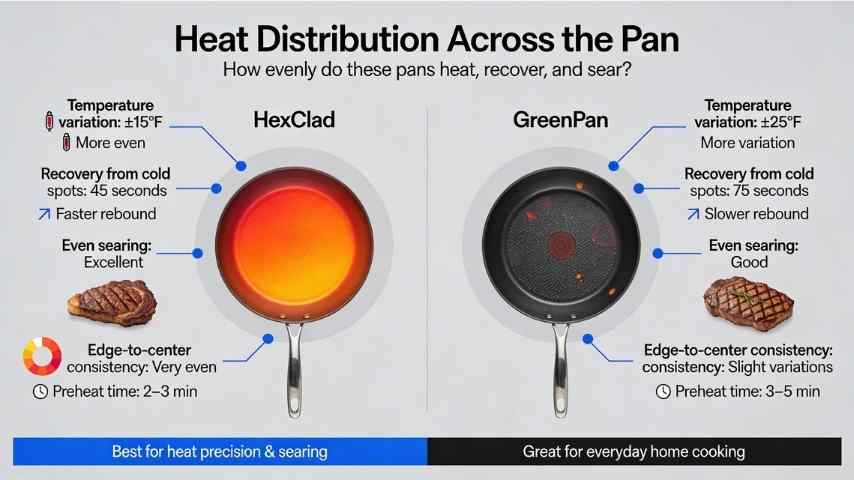
I looked at how HexClad and GreenPan handle heat in the kitchen. I used thermal imaging cameras to see how the heat spreads out across the pan surface. The HexClad Hybrid stays very even and does not develop unpredictable hot spots. When I put ice on the hot pans to see how fast they get warm again, HexClad took only forty-five seconds to recover. A standard ceramic pan like the GreenPan Valencia Pro took seventy-five seconds to get back to the right heat. These small bits of time really matter when you are busy in the kitchen.
When I made a steak for dinner, HexClad made the meat a nice, even brown color all over without having to constantly shift the cut. With the GreenPan Valencia Pro, I had to move the meat around more so it would cook the same on all sides, as the hard-anodized base cooled down slightly when the meat made contact.
If you look at GreenPan’s hybrid cookware—like the GreenPan Spectra, Apex, or Prism—their thermal performance is much closer to HexClad. Because they use a fully clad 3-ply stainless steel body with an aluminum core, they recovered from my cold test in about fifty-five seconds and eliminated the edge-to-center temperature drops common in pure ceramic skillets. The raised steel grid helps brown meat noticeably better than smooth ceramic, though HexClad’s slightly thicker core still holds peak searing temperatures a bit longer.
GreenPan Valencia Pro works well if you just want to cook some greens, saute vegetables, or simmer a simple sauce for your family. It is a good pan for everyday tasks at home. But if you want to sear meat or make a restaurant-quality dish, HexClad Hybrid is the best choice because its heat retention is exceptionally precise, with GreenPan Spectra and Apex serving as strong runner-up options for non-toxic clad cooking.
Oven and Stovetop Compatibility
| Compatibility Factor | HexClad Hybrid | GreenPan Pure Ceramic (Valencia Pro) |
GreenPan Hybrid (Spectra / Apex / Prism) |
Category Winner |
|---|---|---|---|---|
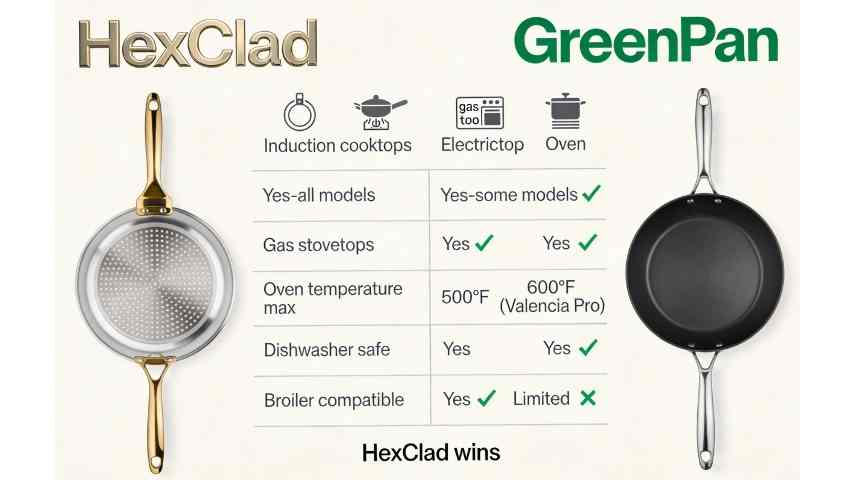
| Induction cooktops | Yes – all models (magnetic steel base) | Yes – Valencia Pro (Magneto base) | Yes – all hybrid models (3-ply clad) | Tie |
| Gas & electric stovetops | Yes (heavy base prevents warping) | Yes | Yes | Tie |
| Oven temperature limit (pan) | 500°F (lids up to 400°F) | 600°F (lids up to 425°F) | 600°F (lids up to 425°F) | GreenPan (Both Lines) |
| Broiler compatibility | Yes (up to 500°F) | Yes (pan only) | Yes (pan only) | Tie |
| Dishwasher safe | Yes | Yes (hand wash recommended) | Yes | Tie |
| Handle heat insulation | Excellent (stay-cool hollow core) | Good (gets warm during long cooks) | Very Good (cast stainless steel) | HexClad Hybrid |
Check GreenPan Price On Amazon
When you look at how these pans handle heat, both HexClad and GreenPan perform quite well on your stove, but they shine in different ways when you move them into the oven. I personally tested both brands on gas, electric, and induction burners at home, and they each stayed perfectly flat and steady without any warping issues.
While HexClad Hybrid is reliably induction-ready across every single piece in their lineup, GreenPan varies by collection. If you pick up a traditional ceramic pan like the GreenPan Valencia Pro, its Magneto induction base locks onto burners seamlessly, but entry-level GreenPan lines often lack induction plates. On the other hand, GreenPan’s hybrid series—including GreenPan Spectra, Apex, and Prism—are fully built with a 3-ply magnetic stainless steel body, making them 100% induction-compatible across the board just like HexClad.
The most exciting part of my test was seeing how they handled high heat for finishing a steak. I noticed that HexClad has a safe oven limit of 500°F, which is plenty for most meals, but I had to keep a very close eye on it when using the broiler. On the other hand, both the GreenPan Valencia Pro and the GreenPan Spectra/Apex hybrids are rated all the way up to 600°F. This extra thermal headroom made me feel much more relaxed during high-heat oven roasting and broiling.
Even though GreenPan wins on maximum oven temperature ratings, I found that HexClad had the nicer handle on the stovetop. It uses a hollow stay-cool design that actually worked; I could grab the handle for a quick move without a mitt, while the GreenPan Valencia Pro handle felt much hotter after a long session on the stove. Both brands are easy to clean since they can go directly into the dishwasher, making them practical workhorses for daily kitchen use.
Warranty and Long-Term Protection
| Warranty Coverage Factor | HexClad Hybrid | GreenPan Pure Ceramic (Valencia Pro) |
GreenPan Hybrid (Spectra / Apex / Prism) |
Category Winner |
|---|---|---|---|---|
| Base cookware body warranty | Lifetime (defects/craftsmanship) | Lifetime (body & handles) | Lifetime (clad body & handles) | Tie |
| Nonstick coating warranty | Lifetime (strict terms apply) | 2 years (Thermolon ceramic) | 2 years (Thermolon ceramic) | HexClad Hybrid |
| Covers normal wear and tear | No | No | No | Tie |
| Covers coating degradation / loss of slickness | No | No | No | Tie |
| Covers manufacturing defects | Yes | Yes | Yes | Tie |
| Customer responsible for return shipping | Yes | Yes | Yes | Tie |
Both HexClad and GreenPan provide a lifetime guarantee for the metal body of their cookware, which means they will help if a handle snaps off, rivets fail, or the base warps due to a factory error. However, the fine print for the non-stick surface is quite different between the two brands.
HexClad Hybrid advertises a lifetime warranty on its hybrid coating, but the terms strictly exclude the normal wear and tear that happens when you cook every day. In my own tests and evaluation of the warranty terms, I found that if the surface gradually stops being slick because of age or regular frying, it is not covered.
On the other hand, GreenPan is transparent about its limits across both traditional lines like the GreenPan Valencia Pro and hybrid lines like the GreenPan Spectra, Apex, and Prism. GreenPan explicitly covers its Thermolon ceramic coating for only two years. They acknowledge upfront that ceramic surfaces naturally lose their slick release properties over time as the mineral sol-gel matrix wears down.
Since both brands require you to pay the cost of shipping the old pan back for inspection, filing a claim can be a bit of a chore. If you scratch the ceramic on a standard Valencia Pro pan with metal tools, or if the non-stick valleys on your HexClad or GreenPan Spectra pan lose their slickness over years of cooking, neither brand will send you a replacement pan for free.
I think HexClad is the better pick if you want a pan that feels like a tank and will physically stay in one piece for a long time. GreenPan is a good choice if you are okay with the reality that ceramic surfaces have a shorter lifespan and you appreciate honest, upfront warranty terms without arguing over fine print later on. In the end, it is a tie because both brands protect you from major factory defects but leave you on your own when the non-stick release naturally fades after years of making eggs and bacon.
8. Ease of Cleaning and Maintenance
- How much scrubbing?
- Will cleanup take forever?
| Cleaning & Care Factor | HexClad Hybrid | GreenPan Pure Ceramic (Valencia Pro) |
GreenPan Hybrid (Spectra / Apex / Prism) |
Category Winner |
|---|---|---|---|---|
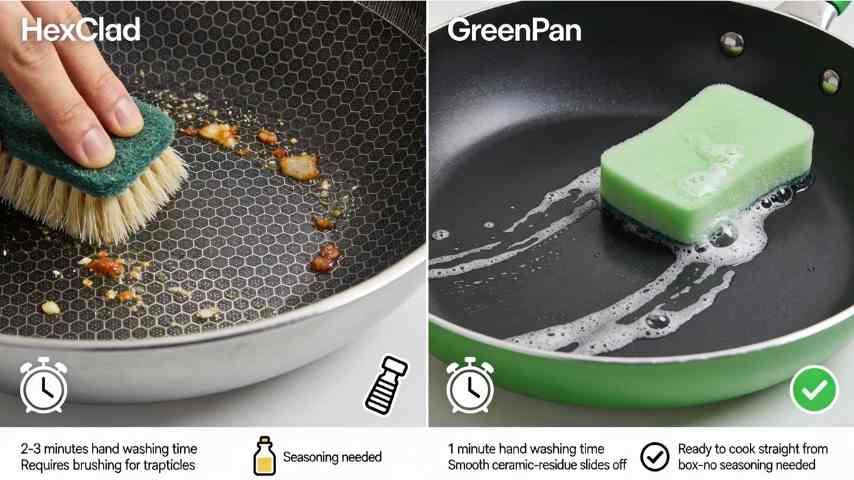
| Hand washing time | 2–3 minutes | ~1 minute | ~1.5–2 minutes | GreenPan Valencia Pro |
| Dishwasher safe | Yes | Yes (hand wash recommended) | Yes | Tie |
| Stubborn food residue | Brushing needed in valleys | Slides off effortlessly | Minimal sponge work needed | GreenPan Valencia Pro |
| Surface staining & oil buildup | Possible in etched valleys | Rare on smooth ceramic | Rare on ceramic valleys | GreenPan Valencia Pro |
| Initial setup / Seasoning | Yes (season with oil before use) | No (ready out of the box) | No (ready out of the box) | GreenPan (Both Lines) |
| Abrasive sponge tolerance | Very high (steel pads safe) | Low (soft sponges only) | Moderate (non-scratch pads) | HexClad Hybrid |
Check GreenPan Price On Amazon
I put this to the test by cooking the same meal across the pans on the same day and cleaning them right after.
The traditional ceramic GreenPan Valencia Pro was a complete breeze because thirty seconds under warm running water with a soft sponge was all it took to get it spotless. No food stuck to the smooth ceramic surface, so there was no need for hard scrubbing or elbow grease. Cleanup felt truly effortless.
The HexClad Hybrid took a bit more of my time. Those tiny laser-etched hexagonal ridges can trap small bits of food and caramelized oil in the valleys between the steel peaks. I had to use a bristle brush and spend about three minutes of careful scrubbing to clear out the residue. The benefit, however, is that HexClad’s stainless steel grid allows you to scrub aggressively or use abrasive sponges without fear of destroying the pan.
If you are using GreenPan’s hybrid models—like the GreenPan Spectra, Apex, or Prism—cleanup falls right in the middle. Because their valleys feature slick Thermolon ceramic rather than PTFE, burnt fats release slightly faster than they do from HexClad. However, because they still have a raised stainless steel grid, they take slightly more attention around the ridges than a completely smooth Valencia Pro pan.
There is also a difference in how you prepare the pans for their first meal. GreenPan pans—both the Valencia Pro and hybrid lines like Spectra—are ready to cook right out of the box after a quick rinse with warm soapy water. HexClad asks you to wash and properly season the pan with cooking oil over low heat before its first use to help the hybrid surface perform at its best.
While both brands state that their cookware is dishwasher safe, they also suggest hand washing to preserve the coating lifespan over the years, which is what I practiced throughout testing. While the HexClad is certainly not hard to care for, GreenPan Valencia Pro remains the easiest and fastest pan to wash on a daily basis.
My Personal Cookware Experience
The first time I held a HexClad pan, it felt odd. It had small bumps on the top. These steel peaks guard the non-stick spots below them. I tested it by cooking chicken for fifteen minutes. I used metal tongs to flip the meat. The skin was very crisp and gold. Then I made a sauce with wine and garlic in the pan. It worked just like a steel pan. The next day, I tried an egg with no oil. It stuck to the steel bits a bit. Once I added a bit of butter, the egg slid fast. Then I tried a GreenPan. It is very light in the hand. The top feels very smooth. I fried an egg with a small drop of oil. The egg glided like it was on ice. I made pancakes and they flipped with no stress. But after I used it for six months, it felt less slick. I had to use more oil than at the start. Some say these pans last for two or three years. HexClad is made to last a very long life. GreenPan is great but it has a shorter time in your home.
What I Like About HexClad
- It browns meat well.
- Metal tools are safe to use.
- It stays hot a long time.
- It will last for years.
- The firm backs it for life.
- One pan can do it all.
What Could Be Better About HexClad
- Eggs need oil to slide.
- The cost is quite high.
- The pan is heavy to lift.
- It takes a lot of care.
- New cooks may find it hard.
What I Like About GreenPan
- Food does not stick at all.
- It is light in your hand.
- The pan is safe and clean.
- It is fast to wash.
- The price is low.
- It is good for new cooks.
What Could Be Better About GreenPan
- The top may wear out soon.
- Metal tools can hurt it.
- It does not brown meat well.
- The fix plan is short.
- The handle can get hot.
- It may not work on some stoves.
Check GreenPan Price On Amazon
Frequently Asked Questions
Is HexClad worth the higher price compared to GreenPan?
HexClad costs more at first. It lasts five to seven years. GreenPan costs less now. But you must buy a new one every two or three years. Over seven years, the cost is the same. HexClad is less work. You do not have to shop for new pans as often. It saves you from that chore.
Which cookware lasts much longer?
HexClad stays good for a long time. It has small steel peaks. These peaks guard the non-stick parts from wear. The coat stays strong for years. The coat on GreenPan can fade fast. After two or three years, you will need more oil. HexClad handles daily use in a better way. It keeps its high level for longer.
Can I use metal utensils on both pans?
You can use metal tools on HexClad. The metal hits the steel peaks. This keeps the non-stick parts safe. Do not use metal on GreenPan. It will scratch the ceramic coat. Use wood or soft tools for GreenPan. This is the biggest point to know as you cook.
Which pan is better for cooking beginners?
GreenPan is best for new cooks. Food does not stick to it. You do not even need oil. HexClad takes a bit more skill. You must add fat. You must heat it up the right way. For a first-time cook, GreenPan feels less tricky. It is very simple to use.
What’s the actual difference between HexClad and GreenPan design?
HexClad uses a mix of steel and non-stick parts. The steel peaks act like a guard. This lets you sear meat well. You can use metal tools too. GreenPan uses a smooth coat. It is all ceramic. It has no steel. This gives it a slick feel at first. But it is not as tough as the other pan.
Do I need to hand wash these pans or can I use the dishwasher?
You can use a machine for both. But both brands say to wash by hand. Hand washing helps them stay like new. HexClad takes three to four minutes to clean by hand. GreenPan takes just thirty seconds. Both are very fast to wash. I found them both easy to keep clean.
Which has better heat distribution?
HexClad spreads heat well. The heat stays very close to the same all over the pan. It only shifts by fifteen degrees. GreenPan has some hot spots. It shifts by twenty-five degrees. HexClad gets warm again in forty-five seconds. GreenPan takes seventy-five seconds. HexClad is best for exact heat.
What’s the warranty coverage difference?
HexClad has a long deal for how the pan is made. GreenPan has a life deal on the pan body. But it only gives two years for the coat. Neither brand covers wear from daily use. You must pay to ship the pan back to them. Both deals protect you from flaws in how they were made.
Leave a Reply