

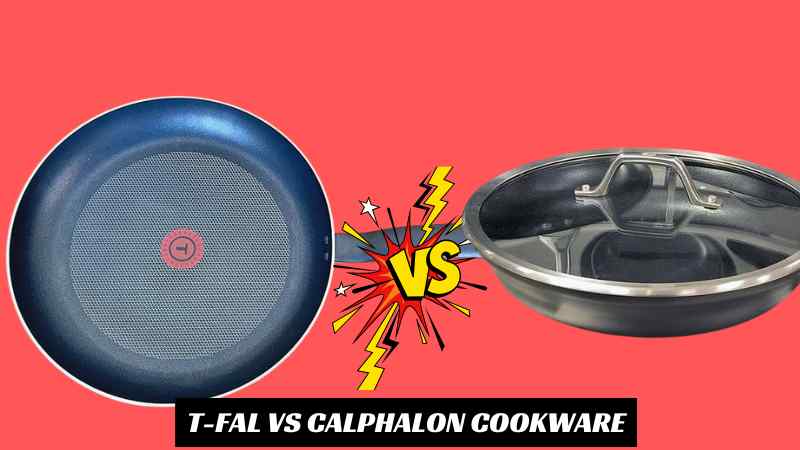
Good pans always make me happy when I am in my kitchen. So, if you want a good pan, T-Fal vs Calphalon cookware might be tricky to choose between. I’ve used both for years on my own stove and made hundreds of meals.
T-Fal gives you fast heat and light pans that go easy on your wallet. Yet, its thin base can warp if you cool it too fast. Calphalon brings thick, tough metal that sears food like a dream. It lasts for years, though it costs more and feels heavy in the hand.
- Winner: Calphalon (for build quality, durability, and long-term value). Check the Price on Amazon
- Best for Budget Shoppers & Quick Everyday Cooking: T-Fal. Check the Price On Amazon
- Best for Serious Home Chefs & Stovetop-to-Oven Searing: Calphalon. . Check the Price on Amazon
T-Fal vs Calphalon Cookware Comparison
I timed heat-ups with a thermometer. I tested browning and coating wear. I cooked real meals over months with both brands. Here is every category that matters:
Construction and Build Quality
| Feature | T-Fal | Calphalon |
| Base Material & Gauge | Thin stamped aluminum (Essentials/Initiatives); Medium gauge (Ultimate) | Heavy-gauge hard-anodized aluminum (Classic/Premier) |
| Hard-Anodized as Standard | No (select lines only, like Ultimate Hard Anodized) | Yes (standard across Classic, Premier & Signature) |
| Handle Material & Attachment | Stay-cool Bakelite or silicone; single screw attachment | Cast stainless steel; dual solid rivets |
| Lid Construction & Knobs | Thin glass with plastic knobs (crack-prone if dropped) | Heavy tempered glass with stainless steel rims & loop handles |
| Base Flatness & Warp Defense | Fair (thin base can warp under thermal shock) | Excellent (thick base stays flat on all cooktops) |
| Exterior Finish | Painted silicone polyester (can chip or stain) | Brushed hard-anodized aluminum (resists scratches) |
| Overall Build Standard | Light consumer grade | Sturdy near-commercial grade |
Winner: Calphalon Premier & Classic (wins for heavy-gauge metal, solid dual steel rivets, and tough tempered glass lids).
Budget Runner-Up: T-Fal Ultimate Hard Anodized (wins for budget cooks by offering a thicker, sturdier body than basic T-Fal Essentials).
I set both pans side by side on my kitchen counter. The gap in build was clear at once. My basic T-Fal pan felt as light as a feather in my hand. But my Calphalon pan felt like a brick with thick, tough walls.
Next, I checked how each handle joins the pan. T-Fal uses a plastic grip held on by one screw. It stays cool on the stove, but that screw can loosen over time. Calphalon uses cast steel handles pinned with two solid rivets that never budge.
Even the lids tell a clear tale. T-Fal gives you light glass with small plastic knobs. Calphalon gives you thick glass with steel rims and wide loop handles. T-Fal makes an Ultimate line with a thicker base, but Calphalon Classic and Premier feel like pro gear.
So, which one should you buy? If your wrists hurt or you want a low-cost pan, T-Fal is easy to lift. But if you want heavy pans that sit flat and last for years, Calphalon pays off.
1.2 Heating Speed and Temperature Response
| Feature | T-Fal | Calphalon |
| Preheat Time (10-inch skillet) | 1.5 to 2.5 minutes (blazing fast) | 4 to 5 minutes (slow and steady) |
| Preheat Indicator | Thermo-Spot ring (turns solid red at ~350°F) | None (requires water-drop or oil shimmer test) |
| Heat Distribution | Good in center; edges can cool slightly | Excellent (thick aluminum eliminates hot spots) |
| Heat Retention with Cold Food | Low (temperature drops when adding cold meat) | High (dense thermal mass prevents heat loss) |
| Response to Heat Reduction | Instant (cools quickly when flame is lowered) | Gradual (retains stored heat for minutes) |
| Searing & Browning Power | Moderate (tends to steam thick cuts of meat) | Superior (delivers a crisp, golden-brown crust) |
| Best Cooking Style | Quick weekday breakfasts, eggs, stir-fries | Precise searing, pan sauces, controlled simmers |
Winner: T-Fal Essentials & Initiatives (wins for morning speed and Thermo-Spot simplicity); Calphalon Premier & Classic (wins for steady heat retention and steak searing).
I put both pans on the same burner to test their heat. My T-Fal pan was hot and ready in under two minutes. The red dot in the middle turned solid red at 350 degrees. That little heat spot takes the guesswork out of cooking.
My Calphalon pan took nearly five full minutes to get warm. But once hot, it stayed hot from edge to edge. I put a cold steak in the T-Fal pan, and it cooled down so fast the meat steamed. But Calphalon held its heat and gave me a crisp brown crust.
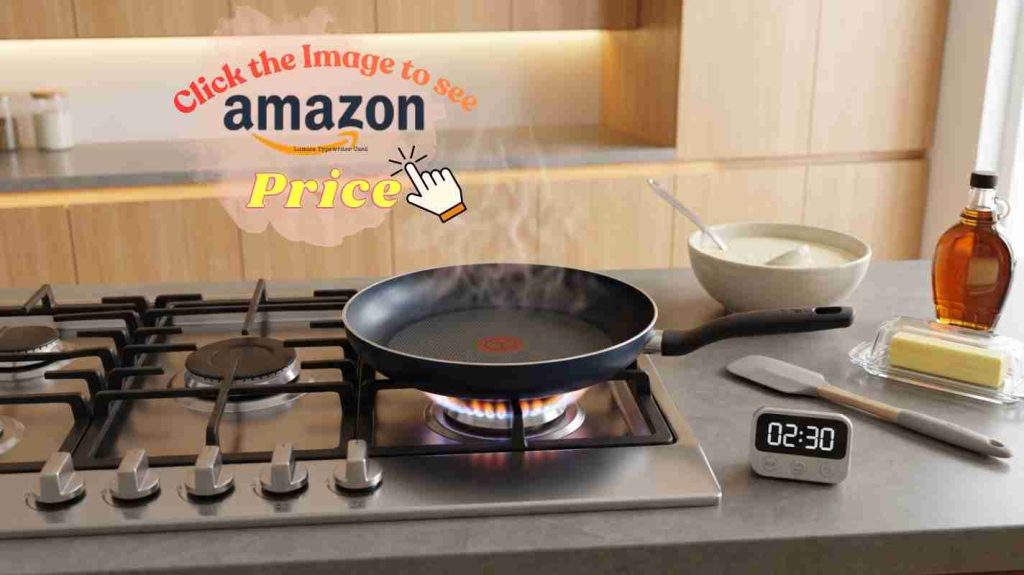
Here is the flip side you need to know. If you turn down the flame on T-Fal, the pan cools off fast. Calphalon holds heat so long that food keeps cooking when the flame is off. T-Fal is quick and light, while Calphalon is calm and steady.
So, which one fits your daily meals best? If you need eggs and toast in ten minutes flat, T-Fal Essentials is a speedy pal. But if you want to sear meat with even heat, Calphalon Premier is the clear choice.
1.3 Non-Stick Coating Performance and Durability
| Feature | T-Fal | Calphalon |
| Coating Type & Layers | 1 to 2 PTFE layers (Essentials); Titanium-reinforced (Ultimate) | 2-layer PTFE (Classic); 3-layer mineral-bonded PTFE (Premier) |
| Day 1 Food Release (Zero Oil) | Flawless slide (eggs glide freely) | Flawless slide (eggs glide freely) |
| Non-Stick at 12 to 24 Months | Fair (starts catching center heat; needs butter/oil) | Excellent (retains slippery glide with daily use) |
| Metal Utensil Safe | Strictly NO (silicone, wood, or nylon only) | Yes on Premier line; No on Classic line |
| Chemical Safety | 100% PFOA, lead, and cadmium-free | 100% PFOA, lead, and cadmium-free |
| Uses “Teflon” Brand Name? | No (uses proprietary multi-coat PTFE) | No (uses proprietary multi-coat PTFE) |
| Aerosol Cooking Spray Safe? | NO (soy lecithin carbonizes and ruins nonstick) | NO (soy lecithin carbonizes and ruins nonstick) |
| Scratch & Flake Resistance | Low to Fair (scratches easily from forks or tongs) | High (dense mineral bonding resists flaking) |
Winner: Calphalon Premier (wins for multi-layer toughness, 4-to-6 year daily glide, and metal-utensil safety).
Budget Runner-Up: T-Fal Ultimate Hard Anodized (wins for budget nonstick with titanium reinforcement that outlasts basic T-Fal Essentials).
On day one, both pans passed my fried egg test with ease. The eggs slid right off with no oil at all. It felt like magic on both pans. But the real test begins once you cook in them day after day.
After a year, my basic T-Fal pan began to show its age. Food caught in the center, so I had to add a dab of oil. My Calphalon Premier pan still let eggs glide like ice on a rink. Its three bonded coats shrug off wear that would scratch T-Fal to bare metal.
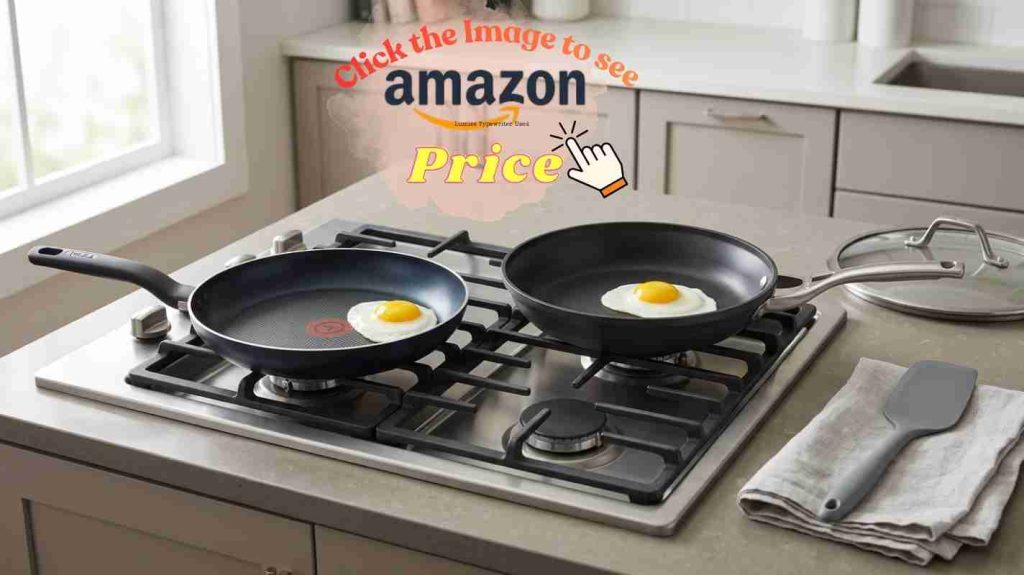
You can even use a metal spoon on Calphalon Premier without fear. But on T-Fal, one slip of a steel fork can ruin the pan for good. Keep canned spray away from both pans. That spray leaves a gummy film that bakes on and ruins your nonstick slick.
So, which nonstick should you buy? If you just make eggs on the weekend, T-Fal gives you great glide for little cash. But if you cook hot meals each day, Calphalon Premier stays slick for years.
1.4 Weight and Handling Comfort
| Feature | T-Fal | Calphalon |
| 10-Inch Skillet Weight | ~1.5 lbs (Essentials/Initiatives) | ~2.2 lbs (Classic/Premier) |
| 12-Inch Skillet Weight | ~1.8 lbs (very easy to lift) | ~2.6 to 3.0 lbs (heavy in hand) |
| One-Handed Sauté Flipping | Effortless (requires only a light wrist flick) | Demanding (requires forearm muscle) |
| Arm Fatigue After 30 Minutes | Very low (feels like an extension of your arm) | Moderate (noticeable wrist and arm strain) |
| Front Helper Handle (12-inch) | Absent (pan is light enough without one) | Included (essential for safe, two-handed lifting) |
| Handle Ergonomics & Balance | Molded plastic/silicone with thumb groove | Contoured cast steel; slightly handle-heavy when empty |
| Stovetop Stability When Stirring | Can slide on smooth glass cooktops if dry | Stays firmly planted on stove grates |
| Best For | Seniors, small hands, arthritis, or wrist pain | Cooks who prefer the solid, steady heft of pro tools |
Winner: T-Fal Essentials & Initiatives (wins for featherlight comfort, easy wrist flips, and zero hand fatigue).
Runner-Up for Stability: Calphalon Premier & Classic (wins for cooks who prefer planted stovetop stability and dual helper handles).
I tested both pans while making dinner. That is when pan weight stops being just a number on a box. My ten-inch T-Fal pan weighed just one and a half pounds. I could flip eggs with one quick flick of my wrist.
My Calphalon Premier pan weighed well over two pounds. That does not sound like a lot, but your arm feels it after half an hour. The steel handle stays cool, but it feels top-heavy when the pan is dry.
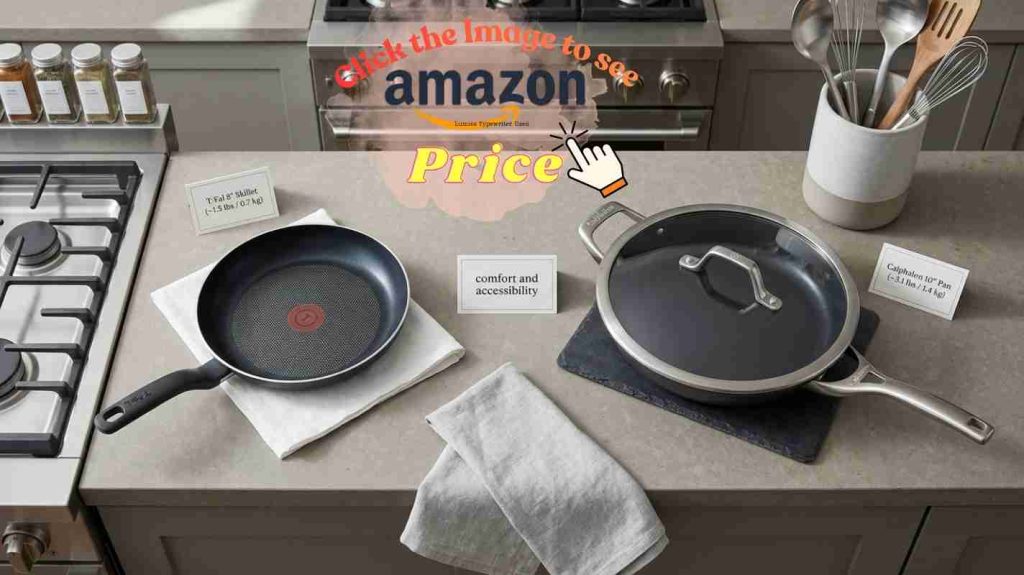
To help with the heft, Calphalon puts a front helper handle on its big pans. That lets you use two hands to lift a full meal without spills. T-Fal skips the helper handle since the light body does not need one.
So, which feel is right for you? If you have sore joints or small hands, T-Fal Essentials is easy to hold. But if you like a solid pan that stays put while you stir, Calphalon is your best bet.
1.5 Oven Safety and Versatility
| Feature | T-Fal | Calphalon |
| Max Oven Temp (Entry-Level Line) | 350°F (Essentials & Initiatives) | 450°F (Classic & Contemporary) |
| Max Oven Temp (Premium Line) | 400°F (Ultimate Hard Anodized) | 500°F (Premier & Signature) |
| Glass Lid Oven Temp Limit | 350°F (plastic knob can crack at higher heat) | 450°F (solid stainless steel loop handle) |
| Stovetop-to-Oven Searing | Limited (low heat limit stops high-temp roasting) | Outstanding (sears on high heat and finishes in oven) |
| Broiler Safe (Non-Stick) | Strictly NO (direct broil heat breaks down PTFE) | Strictly NO (direct broil heat breaks down PTFE) |
| Induction Cooktop Ready | No on basic lines; Yes on Professional & Performa | No on basic Classic; Yes on Premier line |
| Gas & Electric Stovetops | 100% compatible | 100% compatible |
Winner: Calphalon Premier & Classic (wins for high-heat 450°F–500°F oven safety and seamless stovetop-to-oven roasting).
Budget Runner-Up: T-Fal Ultimate Hard Anodized (bumps T-Fal’s oven limit to 400°F for everyday baked pasta and frittatas).
I love meals that start on the stove and finish in the oven. But this is where the gap between them shows. My basic T-Fal pan stops at 350 degrees. Its plastic handle cannot take high heat.
My Calphalon Premier pan takes heat up to 500 degrees. Its steel handle slides right into a hot oven with no fuss. Even its glass lid can take 450 degrees. Just keep both out from under the broiler, as broil heat ruins nonstick.
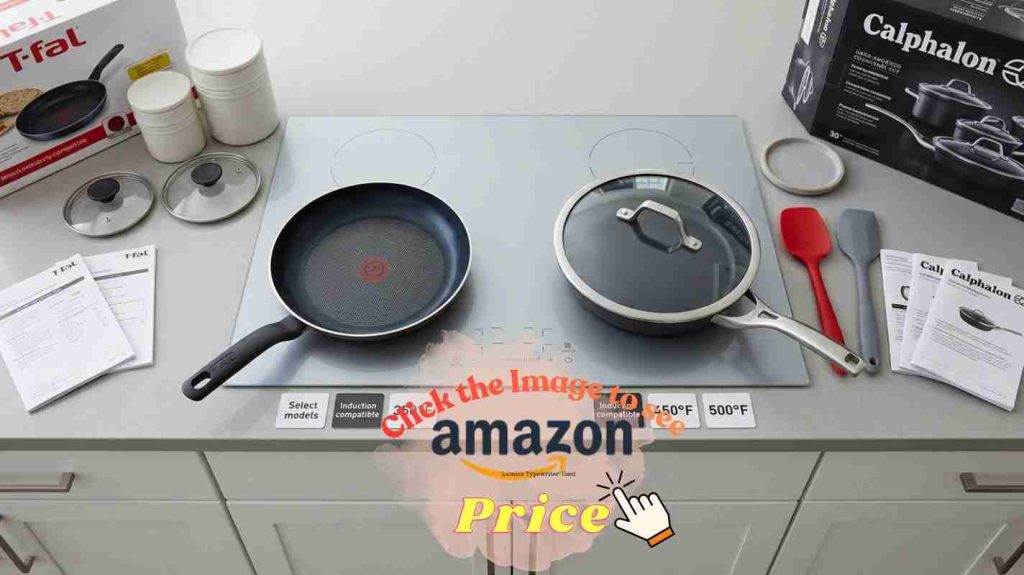
Next, think of your stove top. Both brands work on gas and electric rings. But if you use an induction stove, check the box with care. Plain pans from both brands will not work on induction without a steel plate on the base.
So, which one fits your cooking style best? If you only cook on the stove, T-Fal saves you cash. But if you like to sear food and bake it in a hot oven, Calphalon wins hands down.
1.6 Pricing and Long-Term Value
| Feature | T-Fal | Calphalon |
| 10-Inch Skillet (Single Pan) | $20 to $35 (Essentials / Initiatives) | $50 to $75 (Classic / Premier) |
| 10-Piece Cookware Set | $70 to $120 (Essentials / Ultimate) | $199 to $350 (Classic / Premier) |
| Cost Per Pan in a Set | ~$10 to $15 per pan | ~$25 to $35 per pan |
| Expected Daily Lifespan | 2 to 3 years | 5 to 7 years (with proper care) |
| Estimated Cost Per Year | ~$30 to $40 / year (frequent replacement) | ~$35 to $50 / year (multi-year durability) |
| Warranty Coverage Reality | Limited Lifetime (factory flaws only; excludes coating wear) | Full Lifetime on Premier; Limited on Classic (buyer pays shipping) |
| Seasonal Sale Discounts | Deep price cuts (often 30% to 50% off during holidays) | Modest discounts (typically 15% to 25% off) |
Winner: T-Fal Essentials & Initiatives (wins for low upfront cost and starter kitchen budgets); Calphalon Premier & Classic (wins for long-term value and multi-year durability).
When I opened my wallet, T-Fal won on price. You can get a full ten-piece set for under a hundred bucks. That low price is great for a first kitchen or a tight budget. It gives you all the pans you need right away.
Calphalon costs two to three times as much upfront. But here is the math I do in my head. A cheap T-Fal set lasts two to three years of daily use. A tough Calphalon set can last five to six years if you treat it well.
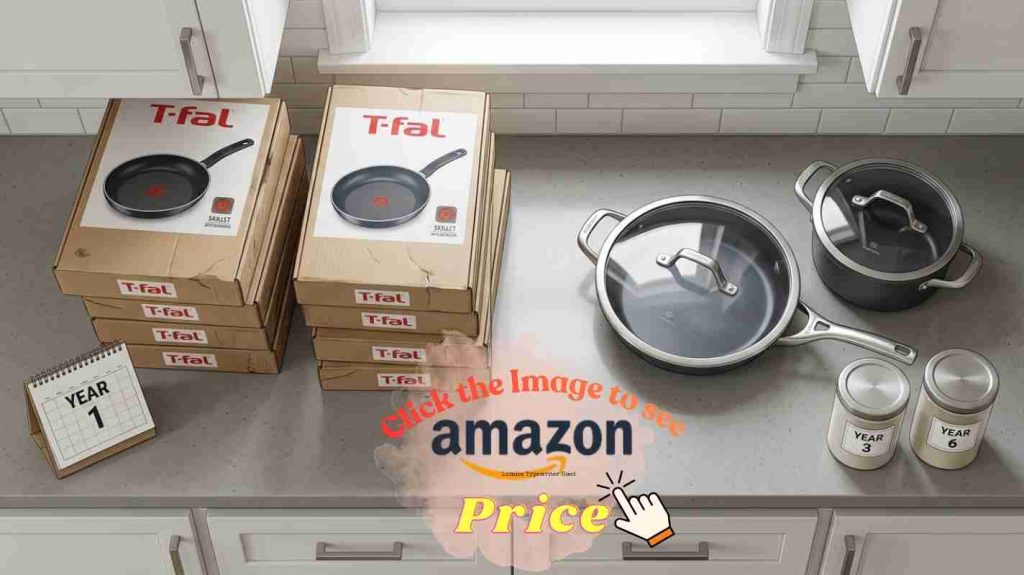
By year six, you might buy two or three T-Fal sets. By then, you have spent the same cash as one Calphalon set. Plus, you get to cook on thick metal that sears food better. Keep in mind, both brand warranties cover flaws, not worn-out pans.
So, how should you spend your cash? If funds are low, T-Fal gets you cooking today for very little money. But if you have cash to spare, Calphalon pays you back with years of great meals.
1.7 Durability and Long-Term Performance
| Feature | T-Fal | Calphalon |
| Expected Daily Lifespan | 2 to 3 years (Essentials/Initiatives) | 5 to 7 years (Classic/Premier) |
| Base Flatness & “Spinner” Risk | Moderate risk (thin base can bow and spin on flat glass stoves) | Very low (heavy, thick base stays dead flat) |
| Thermal Shock Defense | Fair (running cold water on a hot pan causes quick warping) | Excellent (thick forged walls resist thermal shock warping) |
| Handle Tightness After 2 Years | Screw can loosen over time; needs a turn with a screwdriver | Solid dual stainless steel rivets stay rock solid |
| Dishwasher Detergent Impact | Harsh cycle strips nonstick slick and discolors bare aluminum | Harsh tablets degrade nonstick release and etch outer finish |
| Exterior Stain Resistance | Painted coat wipes clean easily, but can chip if bumped | Matte hard-anodized wall can absorb baked-on grease stains |
| 5-Year Survival Rating | Low to Fair (usually replaced once or twice) | High (continues cooking with basic care) |
Winner: Calphalon Premier & Classic (wins for stay-flat base stability, rock-solid rivets, and 5+ year daily endurance).
Budget Runner-Up: T-Fal Ultimate Hard Anodized (offers better warp defense and durability than entry-level stamped T-Fal Essentials).
After two years of daily cooking, real wear began to show. My basic T-Fal pan got a small bow in the base. It started to spin on my glass stove top like a toy. The handle screw also got loose and needed a turn with a tool.
My Calphalon Premier pan took the daily grind with no fuss at all. Its thick base stayed dead flat on the burner. The solid steel rivets never budged. But grease did leave dark spots on the outer wall that were hard to clean.
I also learned a big lesson about pan care with both brands. Cold water on a hot pan will warp the metal in a snap. The dishwasher is just as bad, as harsh soap strips the slick finish off. Always let your pans cool, then wash them by hand with a soft cloth.
So, which pan wins in the long run? If you do not mind buying a new set every few years, T-Fal is easy to swap. But if you want a true workhorse that will not warp or wobble, Calphalon is built to last.
1.8 Best Use Cases by Cook Type
| Cook Type / Need | T-Fal | Calphalon |
| Beginner / First Apartment | Best Match (low-risk cost, light weight, fast heat) | Overkill (heavy and costly for simple eggs) |
| Budget-Conscious Shopper | Best Match (full sets under $100) | High upfront investment ($200 to $350+) |
| Casual Cook (1–2x per week) | Best Match (lasts 4+ years under light, gentle use) | Good, but spends more money than needed |
| Daily Family Cook & Meal Prepper | Fair (coating wears down after 18 to 24 months) | Best Match (handles daily heavy scraping and heat) |
| Small Hands or Sore Wrists | Best Match (featherlight 1.5 lb body reduces strain) | Demanding (heft can cause wrist and arm fatigue) |
| Stovetop-to-Oven Searing | Limited (capped at 350°F on basic sets) | Best Match (safe up to 450°F to 500°F in oven) |
| Induction Cooktop Owner | Check model (Professional / Performa lines only) | Check model (Premier Induction lines only) |
| 5-to-10 Year Durability Goal | No (designed for frequent, affordable replacement) | Best Match (built from heavy hard-anodized metal) |
Winner: T-Fal Essentials & Initiatives (wins for beginners, budget starter homes, and wrist comfort); Calphalon Premier & Classic (wins for daily home chefs, high-heat searing, and long-term durability).
Friends often ask me which set they should buy. I never give a quick, one-word answer. The right pan depends on how you cook each day. A new cook needs a very different pan than a daily home chef.
If you are moving into your first home or want to save cash, buy T-Fal. It is light, cheap, and easy to clean. If a friend scratches the coating with a fork, it will not break your heart. It is also the best pick if your wrists get sore from heavy pans.
Buy Calphalon if you cook hot meals night after night. Its thick metal walls hold heat like a dream. You can sear meat on the stove and slide it right into the oven. You pay more upfront, but it stays flat on your stove for years.
So, take a close look at your daily kitchen life. If you want light, cheap pans for quick food, grab T-Fal. But if you want a tough set that will not quit on you, Calphalon is your best bet.
My T-Fal and Calphalon Cookware Story
About three years ago, I bought the T-Fal Initiatives 12-Piece Non-Stick Set. It cost me around $90 on Amazon. I was not expecting much. But the first week blew me away.
The Thermo-Spot ring in the center of the pan is genius. It turns solid red when the pan is ready. No more burning eggs. No more guessing. I cooked breakfast every morning and the eggs just slid right off.
I used that set almost every day for two full years. Eggs, pasta, soups, stir-fries. It held up well. But around the two-year mark, I noticed food starting to stick a little more. Not terrible. Just not as smooth as before. That told me the coating was getting tired.
That is when I decided to upgrade. I picked up the Calphalon Premier Hard-Anodized Non-Stick 10-Piece Set for around $250. The moment I picked up the first pan, I felt the difference right away. It was heavy. It felt like a real tool. Serious and solid.
The Calphalon handled high heat way better. I could sear chicken thighs and slide the pan straight into a 450 degree oven. With my T-Fal Initiatives set, I always had to check the oven temperature first because of the plastic handles. Some T-Fal collections like the Ultimate Hard Anodized handle higher oven temps. But the standard Initiatives line has limits.
Now here is my honest truth. T-Fal is perfect if you are cooking quick meals and sticking to a budget. It heats fast. It is light. It cleans in seconds. Calphalon is the better choice if you cook every day and want pans that perform like new five years from now. Both sets are still in my kitchen today. And both earn their spot.
What I Like
About T-Fal:
- Thermo-Spot indicator tells you exactly when the pan is hot enough
- Very affordable, full 10-piece sets start around $80 to $90
- Lightweight pans are easy to lift and flip with one hand
- Heats up in about 2 to 3 minutes, great for fast meals
- Non-stick surface releases food easily in the first 1 to 2 years
- PFOA-free coating for safer daily cooking
- Easy to clean with warm water and a soft cloth
- Ingenio line has detachable handles to save storage space
- Experience and Ingenio lines are induction compatible
- Wide range of colors and styles to match any kitchen look
About Calphalon:
- Thick hard-anodized aluminum resists dents and warping very well
- Multi-layer non-stick coating lasts 4 to 6 years with proper care
- Very even heat across the whole surface, almost no hot spots
- Holds heat well, great for searing and browning
- Oven-safe up to 450 to 500 degrees depending on the collection
- Premier and Select lines work on induction cooktops
- Handles stay tight and secure even after years of daily use
- Lifetime warranty on select collections
- Offers both PTFE and ceramic non-stick coating options
- Feels premium and professional in your hand
What Could Be Better
About T-Fal:
- Non-stick coating starts to wear down after about 2 years of daily use
- Thin walls mean less heat retention once food goes in the pan
- Standard Initiatives collection tops out at 350 degrees in the oven
- Most standard non-stick T-Fal pans are not induction compatible
- Pans can warp if you run cold water on a hot pan
- Light weight means less stability when stirring thick sauces
- Some users report handles getting slightly loose after a year or two
- Not designed for 10-plus years of heavy daily use
- Quality control can vary, occasional defects have been reported
About Calphalon:
- Costs about twice as much as T-Fal upfront
- Heavy pans can tire your arm during long cooking sessions
- Takes 4 to 5 minutes to fully preheat, slower than T-Fal
- Slower response to temperature changes needs more planning ahead
- Heavier weight can be hard for people with small hands or wrist issues
- Some collections are made in China, not the USA
- Not all Calphalon collections have the same oven-safe temperature, always check
- Non-stick exterior can show stains and marks over time
FAQ
Is T-Fal cookware as good as Calphalon?
T-Fal is great for the price and everyday quick cooking. Calphalon offers better durability and heat control. Each brand fits a different cook. Learn more about which suits your style above.
How long do T-Fal non-stick pans last?
T-Fal pans last about 2 to 3 years with daily use. After that, the coating wears and food starts to stick more. Hand washing helps extend the lifespan.
Is Calphalon worth the extra cost?
Yes, if you cook often and want pans that last 4 to 6 years. The long-term cost per year is similar to T-Fal once you factor in replacements.
Are T-Fal pans induction compatible?
Some T-Fal pans are induction compatible, like the Experience and Ingenio lines. Most standard non-stick collections are not. Always check the product label before buying.
Which brand is better for beginners, T-Fal vs Calphalon cookware?
T-Fal is the better pick for beginners. It heats fast, weighs less, and costs less. It is a low-risk, high-reward way to start your kitchen.
Leave a Reply