

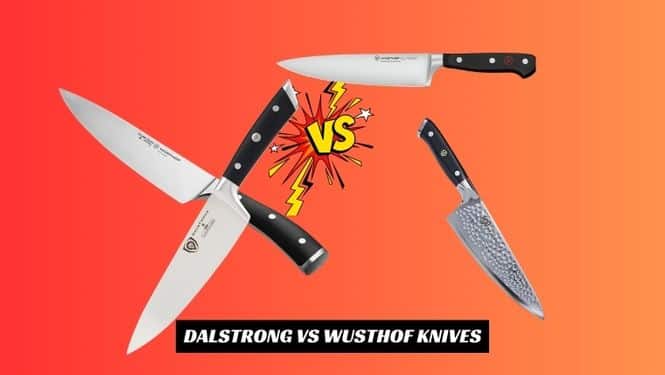
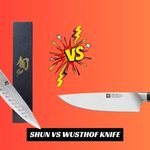
When you shop for Dalstrong vs Wusthof knives, you face a choice between bold modern flash and old-world German grit. I spent months slicing meat, herbs, and winter squash with both brands on my home wood block.
Dalstrong feels like a sports car that glides through soft food at a fair price, though its hard edge needs gentle care. Wüsthof acts like a heavy work truck that shrugs off tough bones for decades, even if it costs more up front.
- Choose the Dalstrong Shogun 8″ Chef’s Knife if: You want a scalpel-sharp edge for boneless meat and veggies, love hammered Damascus blade art, sharpen on flat whetstones, and want a protective drawer sheath for $129.
- Choose the Wüsthof Classic 8″ Chef’s Knife if: You want a tough German workhorse for $170 that powers through whole chickens and hard squash, resists rust and chips in a busy family kitchen, and hones back in seconds on a standard steel rod.
- Choose the Wüsthof Classic Ikon 8″ Chef’s Knife if: You love tough German steel for $200, but you want a contoured handle and a sloped half-bolster so you can sharpen the full blade edge from heel to tip.
- Choose the Dalstrong Gladiator 8″ Chef’s Knife if: You want forged German steel with NSF certification for a pro kitchen, and you need to stay in the $50 to $60 budget range.
Dalstrong vs Wusthof Knives
I spent weeks testing both 8-inch blades on meat, veggies, herbs, and fruit in my home kitchen. I checked their weight, edge life, grip feel, and stone care side by side in real prep. Use my 12 tables below to see which knife fits your cooking style best.
Brand Story, Steel, and Side-by-Side Specs
When I set these blades on my board, I checked their roots first. Picking a chef knife feels like choosing a close friend for daily meals. Wüsthof brings two hundred years of old world pride, while Dalstrong brings bold new craft. Let us see how their brand stories and core steel specs stack up.
| Feature | Dalstrong (Shogun 8″ & Gladiator 8″) | Wüsthof (Classic 8″ & Classic Ikon 8″) |
| Year Founded & Founder | 2014 by Dave Dallaire (some blogs list 2012) | 1814 by Johann Abraham Wüsthof (Classic line in 1886) |
| Current Ownership | Founder-led global team (350,000+ cooks) | 7th-gen family owned (Viola & Harald Wüsthof) |
| Brand Headquarters | Toronto, Canada | Solingen, Germany (US hub in Norwalk, CT) |
| Where Blades Are Made | Yangjiang, China (1,500-year blade hub) | 100% in Solingen, Germany (“City of Blades”) |
| Core Steel by Model | Japanese AUS-10V (Shogun 8″) / German X50CrMoV15 (Gladiator 8″) | German X50CrMoV15 steel across all lines |
| Blade Logo & Markings | Lion head logo + Tsunami Rose wave pattern | Three-Point Trident logo + X50CrMoV15 alloy stamp |
| Total Length & Blade Length | 13.1 inches total (8.03-inch blade) | 13.0 inches total (8.0-inch blade) |
| Spine Thickness at Heel | 2.2 mm slim spine with distal taper | 3.0 mm stout spine with distal taper |
- Winner: Wüsthof Classic 8″ & Wüsthof Classic Ikon 8″ win for 200-year German family heritage and thick 3.0 mm spine strength; Dalstrong Shogun 8″ wins for Japanese AUS-10V super steel and slim 2.2 mm slicing geometry; Dalstrong Gladiator 8″ wins for budget German steel value.
When I held both knives up to the light, two worlds met in my hand. Johann Wüsthof started his shop in 1814 in Solingen, the famed City of Blades. Viola and Harald Wüsthof still run that seventh-gen shop now. Their Classic line dates to 1886 and feels like an old stone fort.
On the flip side, Dalstrong is the bold young kid on the block. Dave Dallaire started the brand in 2014 in Toronto after long shifts in hot kitchens. Some sites list 2012, yet the shop grew fast to serve 350,000 cooks. While Wüsthof just makes knives, Dalstrong sells pans, boards, and chef gear too.
Friends ask me why Dalstrong stamps China on a blade with Japan steel. To keep your cost low, the team ships raw steel to Yangjiang, China. That old town has 1,500 years of knife craft, so my Shogun 8″ felt great for less cash. Each Wüsthof Classic 8″ and Classic Ikon 8″ comes straight from Solingen.
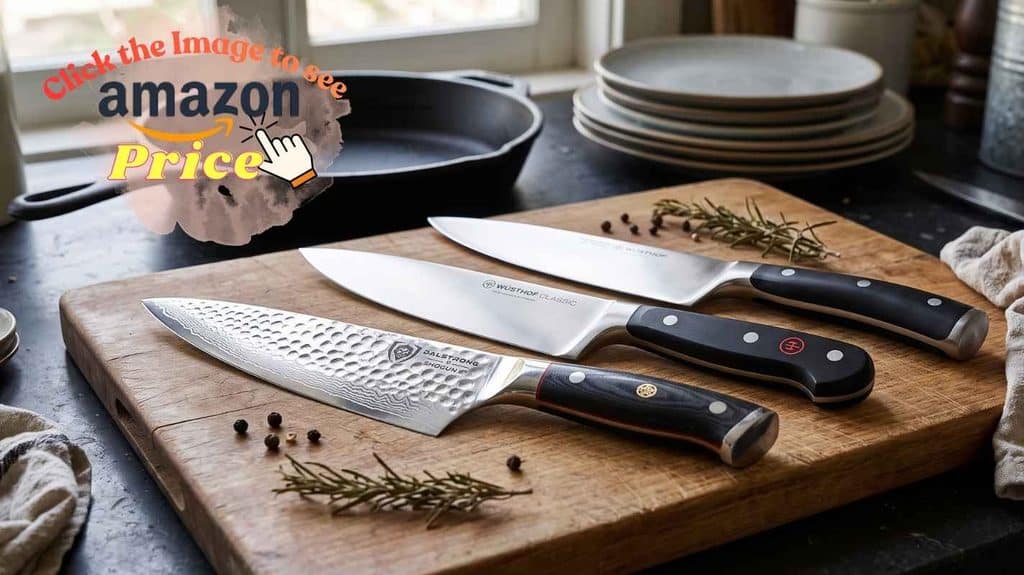
I looked close at the marks etched right on the face of each blade. My Wüsthof Classic 8″ shows a three-point crest and prints X50CrMoV15 on the steel. My Dalstrong Shogun 8″ packs an AUS-10V core and a lion head with Tsunami Rose art. If you want that tough mix in a Dalstrong grip, the Gladiator 8″ uses X50CrMoV15 too.
On my tape, both knives span right near 13 inches from tip to butt. The Dalstrong Shogun 8″ has an 8.03-inch blade and a slim 2.2 mm spine. That thin top helps it glide through soft food with ease. The Wüsthof Classic 8″ has an 8.0-inch blade and a thick 3.0 mm spine that tapers to the point.
So which knife brand fits your hand and home best? Pick the Wüsthof Classic 8″ or Classic Ikon 8″ if you love old-world roots and a stout spine. Grab the Dalstrong Shogun 8″ if you want bold Japanese steel art for less cash. Or choose the Dalstrong Gladiator 8″ if you want tough steel on a small budget.
1. Product Data and Quick Yes/No Check
| Feature | Dalstrong (Shogun 8″ & Gladiator 8″) | Wüsthof (Classic 8″ & Classic Ikon 8″) |
| Forged Full-Tang Build | Yes (Both Shogun 8″ and Gladiator 8″) | Yes (Both Classic 8″ and Classic Ikon 8″) |
| Includes Locking Blade Sheath | Yes (Custom Saya guard with locking pin) | No (Must buy separate $10 blade guard) |
| Includes Wipe Cloth & Chef Pin | Yes (Microfiber cloth, pin, and care guide) | No (Bare knife only) |
| Gift-Ready Magnetic Box | Yes (Heavy magnetic presentation box) | No (Standard thin retail cardboard box) |
| 70-Day Money-Back Home Trial | Yes (70-day full refund test on your board) | No (30-day return on unused knives only) |
| Liquid Nitrogen Cryo-Treated | Yes (Deep-chilled to boost steel strength) | No (Standard heat temper) |
| NSF Pro Kitchen Certified | Gladiator 8″: Yes / Shogun 8″: No | Classic 8″: Yes / Classic Ikon 8″: No |
- Winner: Dalstrong Shogun 8″ Chef’s Knife wins for luxury gift packaging, included locking sheath, and 70-day home trial; Dalstrong Gladiator 8″ & Wüsthof Classic 8″ tie for NSF pro kitchen certification; Wüsthof Classic Ikon 8″ wins if you only want a bare German upgrade blade.
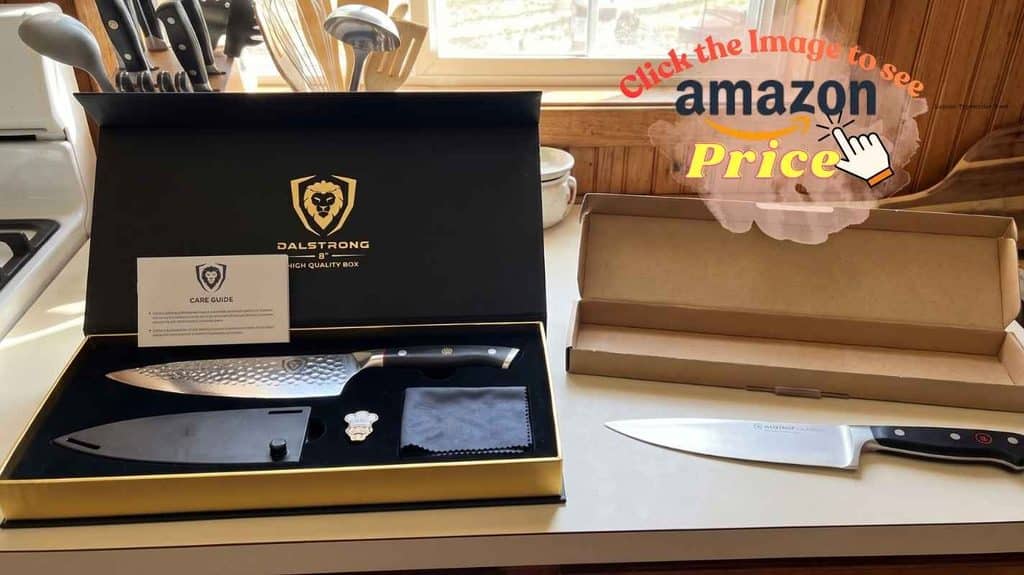
Opening both boxes on my bench felt like night and day. My Dalstrong Shogun 8″ box felt like a fine gold watch case. The thick lid popped open on a strong magnet to show the blade. Inside, I found a soft wipe cloth, a care guide, and a cool chef pin.
Best of all, both the Dalstrong Shogun 8″ and Gladiator 8″ ship with a hard guard. A small peg locks that sheath tight so the blade stays safe in a bag. My Wüsthof Classic 8″ and Classic Ikon 8″ came in plain thin boxes. They had no free gifts inside, so I spent ten bucks on a guard.
Dalstrong also gives you a full 70-day test right on your home board. If the grip does not fit your hand, you can send it back for all your cash. Wüsthof gives you a strict 30-day return rule on blades you have not used. Dalstrong also chills its steel in cold nitrogen to boost blade strength.
Here is one big check if you work in a pro kitchen with strict health rules. Both the Wüsthof Classic 8″ and the Dalstrong Gladiator 8″ pass full NSF health checks. Their smooth steel and sealed grips leave no gaps where raw food can hide. The Dalstrong Shogun 8″ skips that NSF stamp due to its deep art and brass pin.
So which box gives you the best start on day one? Pick the Dalstrong Shogun 8″ if you want a gift box, a sheath, and a 70-day home test. Grab the Dalstrong Gladiator 8″ if you want that same free sheath plus NSF tags for less cash. Or choose the Wüsthof Classic 8″ or Ikon 8″ if you just want a bare German blade.
2. How They Are Made
| Feature | Dalstrong (Shogun 8″ & Gladiator 8″) | Wüsthof (Classic 8″ & Classic Ikon 8″) |
| Construction Style | Shogun 8″: Cladded core (66 steel layers + 2 nickel bands = 67 layers) / Gladiator 8″: Mono-steel bar | Mono-steel (Forged from one solid bar of German steel) |
| Build Timeline & Process | 60-day hand-polished build (Shogun 8″) | 40+ step precision forging (300 smiths + 112 factory robots) |
| Carbon Content | Shogun 8″: 0.95% to 1.1% Carbon / Gladiator 8″: 0.55% Carbon | 0.55% Carbon across both Classic 8″ and Classic Ikon 8″ |
| Added Toughness Metals | Vanadium + 2-layer Nickel core shield (Shogun 8″) | 0.4% Vanadium + Molybdenum (for wear & impact strength) |
| Polished Spine & Choil | Yes (Hand-rounded smooth spine and neck) | Moderate (Slightly squared spine edges) |
| Drop & Impact Resistance | Shogun 8″: Moderate (Hard core can chip) / Gladiator 8″: High | Very High (Ductile steel bends before snapping) |
- Winner: Wüsthof Classic 8″ & Classic Ikon 8″ win for tank-like single-bar impact toughness; Dalstrong Shogun 8″ wins for 67-layer Damascus craft, high carbon density, and a silky hand-rounded spine; Dalstrong Gladiator 8″ wins for mono-steel toughness on a budget.
I always rub my thumb down the top spine of a new knife first. That quick touch tells me how much care went in the build. My Dalstrong Shogun 8″ wraps 66 steel coats and two nickel bands round one hard core. Those 67 folds shield the thin core so it stays strong on my board.
My Wüsthof Classic 8″ and Classic Ikon 8″ take a pure old world path. Skilled smiths and shop bots forge each blade from one solid bar in 40 steps. The Dalstrong Gladiator 8″ uses that same one-bar build style too. Next to them, my Shogun 8″ took 60 full days to fold, press, and buff by hand.
Deep in the blade, the carbon mix drives how each tool acts in hand. The Dalstrong Shogun 8″ packs 0.95% to 1.1% carbon so the core stays rock hard. Both Wüsthof blades and the Gladiator 8″ use 0.55% carbon with 0.4% vanadium for wear life. That soft mix keeps the steel tough so it bends and will not snap.
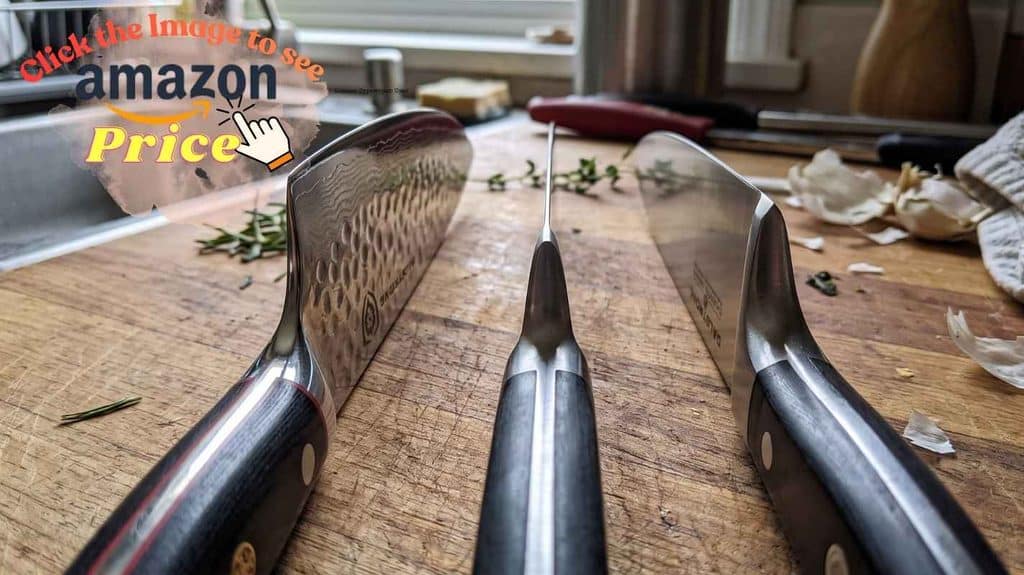
In long prep, the buffed top spine on my Dalstrong Shogun 8″ felt like silk. Its round neck never rubbed my skin raw when I choked up on the steel. My Wüsthof Classic 8″ has a square top ridge, yet it shrugs off hard drops in the sink. If you drop the Shogun 8″ on hard tile, that thin tip can chip.
So which build style should you trust on your home block? Buy the Wüsthof Classic 8″ or Classic Ikon 8″ if you want one solid bar that shrugs off rough drops. Pick the Dalstrong Shogun 8″ if you love 67-fold wave art and a smooth, round spine. Or grab the Dalstrong Gladiator 8″ if you want one-bar grit for less cash.
3. Blade Hardness and How Sharp It Gets
| Feature | Dalstrong (Shogun 8″ & Gladiator 8″) | Wüsthof (Classic 8″ & Classic Ikon 8″) |
| Rockwell Hardness (HRC) | Shogun 8″: 62+ HRC / Gladiator 8″: 56+ HRC | 58 HRC (Both Classic 8″ and Classic Ikon 8″) |
| Factory Edge Angle | Shogun 8″: 8°–12° per side / Gladiator 8″: 16°–18° | 14° per side (28° total; 20% sharper than old 22° edge) |
| Out-of-Box BESS Score | Shogun 8″: ~100 BESS (Scalpel level) / Gladiator 8″: ~155 BESS | ~140 BESS (Razor utility level) |
| Grind Method | Hand-finished 3-step Honbazuke mirror grind | Laser-measured PEtec robotic whetstone grind |
| Bevel Symmetry (Left/Right Hand) | 50/50 symmetrical double bevel (Fits both hands) | 50/50 symmetrical double bevel (Fits both hands) |
| Holds a 10° Thin Edge | Shogun 8″: Yes / Gladiator 8″: No | No (58 HRC steel folds below 14°) |
- Winner: Dalstrong Shogun 8″ Chef’s Knife wins for scalpel-like 62+ HRC hardness and an 8°–12° Honbazuke edge (~100 BESS); Wüsthof Classic 8″ & Classic Ikon 8″ win for a consistent 14° PEtec laser edge at 58 HRC that will not chip; Dalstrong Gladiator 8″ wins for a forgiving 16°–18° budget edge.
To test raw bite on day one, I held a thin receipt in the air. I dropped each blade straight down with no push at all. My Dalstrong Shogun 8″ hit near 100 BESS and glided right through that sheet. My Wüsthof Classic 8″ scored near 140 BESS, which shaved my arm hair with ease.
Most home cooks think edge slope is all that counts on a knife. In truth, steel grit is what holds a thin edge up on your board. My Dalstrong Shogun 8″ hits 62+ HRC, so its stiff core holds an 8 to 12 degree cut. If you grind 58 HRC Wüsthof steel to 10 degrees, that soft edge will fold right over.
My old Wüsthof from years back had a wide 22 degree edge that felt thick. Now, the Wüsthof Classic 8″ and Ikon 8″ use a PEtec grind at 14 degrees per side. That smart scan makes new Wüsthof blades cut 20% more fine than old ones. Next to them, the Gladiator 8″ sits at 56+ HRC with a 16 to 18 degree edge.
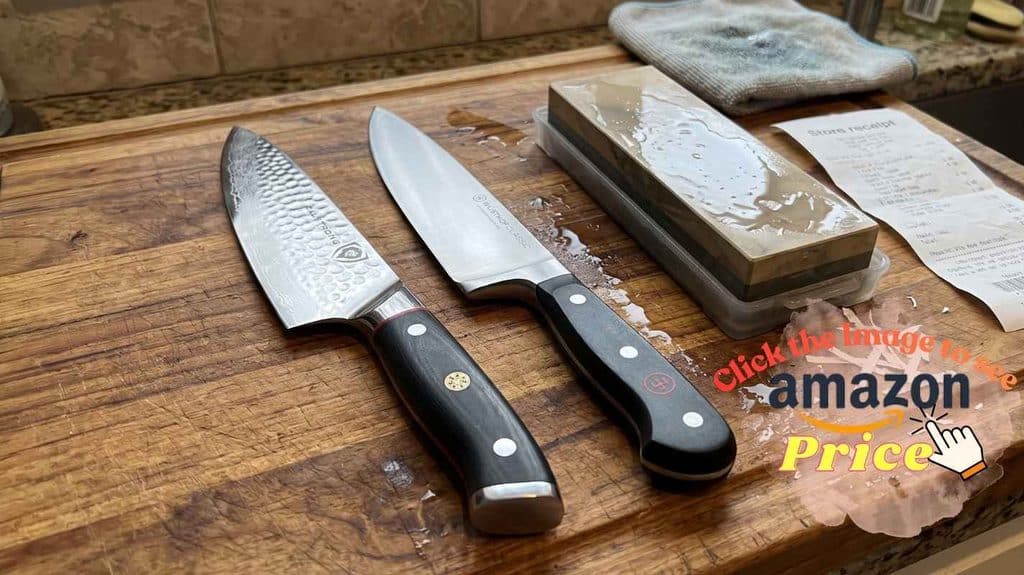
Smiths buff the Dalstrong Shogun 8″ by hand in three steps to get a mirror edge. Wüsthof uses wet stones and bots to keep each 28 degree total edge the exact same. Best of all, both brands grind a 50/50 even edge on both sides of the blade. That means left-hand and right-hand cooks get straight cuts that never steer off course.
So which edge style will make you smile most at meal time? Grab the Dalstrong Shogun 8″ if you crave thin 10 degree cuts right out of the box. Pick the Wüsthof Classic 8″ or Ikon 8″ for a stout 14 degree edge that will not fold. Or choose the Gladiator 8″ if you want a tough edge for less cash.
4. Weight and How It Feels in Your Hand
| Feature | Dalstrong (Shogun 8″ & Gladiator 8″) | Wüsthof (Classic 8″ & Classic Ikon 8″) |
| Total Scale Weight | Shogun 8″: 9.48 oz / Gladiator 8″: 9.7 oz | Classic 8″: 9.1 oz / Classic Ikon 8″: 9.5 oz |
| Balance Point | 1 inch behind bolster (Heavy rear steel end-cap) | Classic 8″: Center on bolster / Classic Ikon 8″: 1 inch back |
| Blade Profile Curve | Shogun 8″: Flatter Gyuto hybrid / Gladiator 8″: Curved belly | Deep German rocking belly on both models |
| Best Cutting Motion | Shogun 8″: Push-cuts, tap-chops, and long pull slices | Fast rock-chopping across herbs and mirepoix |
| Pinch Grip vs. Fist Hold | Best in a full-fist handle grip (Tip feels light) | Classic 8″: Best in a chef pinch grip / Ikon 8″: Palm hold |
| Wrist Fatigue (30-Min Prep) | Mild rear pull in a pinch grip; low in a fist hold | Classic 8″: Very low in a pinch grip (Pivots like a seesaw) |
- Winner: Wüsthof Classic 8″ Chef’s Knife wins for dead-center pinch-grip balance and effortless rock-chopping; Dalstrong Shogun 8″ wins for flat-belly push-cuts and full-fist handle balance; Wüsthof Classic Ikon 8″ & Dalstrong Gladiator 8″ win if you want a deep German rocking belly with palm-weighted heft.
I set all four knives on my scale right for a big soup prep. My Wüsthof Classic 8″ weighed a trim 9.1 oz on the dot. My Dalstrong Shogun 8″ hit 9.48 oz, while the Gladiator 8″ and Ikon 8″ sat near 9.6 oz. On the scale those marks look close, yet each tool feels worlds apart in hand.
The real truth lies in where the weight sits when you lift the steel. My Wüsthof Classic 8″ rests dead flat on the front guard like a seesaw. The Dalstrong Shogun 8″, Gladiator 8″, and Wüsthof Ikon 8″ all wear a steel cap on the butt. That back cap pulls the weight one inch back into your palm.
I diced five pounds of roots and stalks for half an hour to test wrist strain. When I used a chef pinch grip on the blade, the Wüsthof Classic 8″ felt light and calm. In that same pinch hold, the rear cap on my Shogun 8″ tugged back on my wrist. Yet when I held the grip in a full fist, that back weight made the Shogun 8″ tip feel super fast.
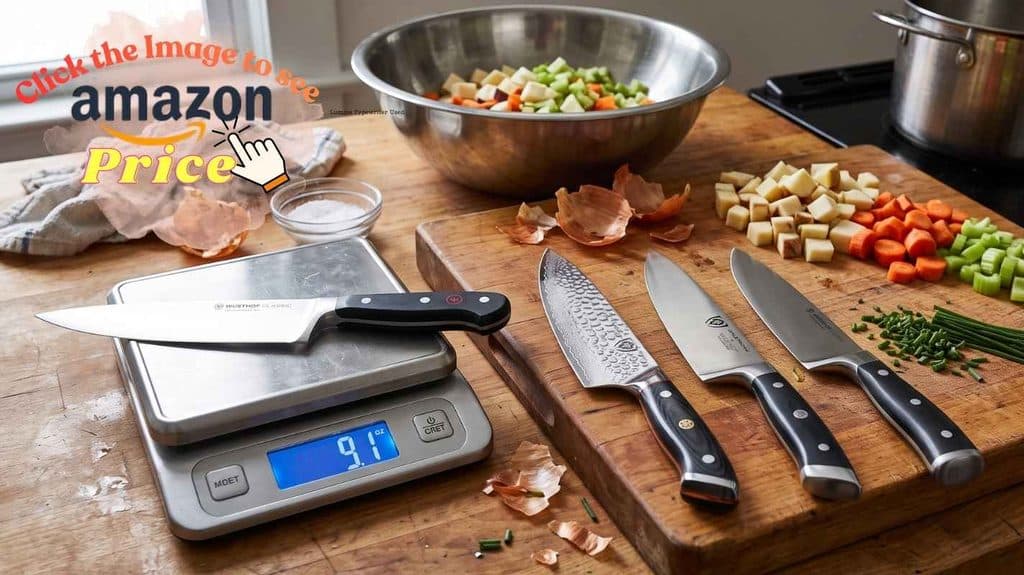
Their blade curves also shape how your arm moves on the wood board. Both Wüsthof knives and the Gladiator 8″ have a deep curve that rocks like a boat. My Dalstrong Shogun 8″ has a flat belly that lands flush on the board. That flat sweet spot gave me clean push cuts on green chives with zero stringy links.
So which heft and curve match your daily prep style best? Pick the Wüsthof Classic 8″ if you use a pinch hold and love to rock chop fast. Grab the Dalstrong Shogun 8″ if you hold the grip in a full fist and push cut straight down. Or get the Wüsthof Ikon 8″ and Gladiator 8″ if you want a rock curve with palm weight.
5. The Bolster and Finger Guard
| Feature | Dalstrong (Shogun 8″ & Gladiator 8″) | Wüsthof (Classic 8″ & Classic Ikon 8″) |
| Bolster Style | Sloped half-bolster on both Shogun 8″ & Gladiator 8″ | Classic 8″: Full bolster to heel / Classic Ikon 8″: Half-bolster |
| Pinch Grip Comfort | Smooth, sloped neck (No hard ridge on index finger) | Classic 8″: Thick metal finger wall / Classic Ikon 8″: Sloped neck |
| Full Edge Cuts to Heel | Yes (Entire 8″ blade cuts & nicks potato eyes) | Classic 8″: No (Back 0.25″ is blunt steel) / Ikon 8″: Yes |
| Whetstone & Slot Access | Easy full-length access on flat stones & slot tools | Classic 8″: Guard hits stone & blocks back 0.5″ in slot tools |
| Long-Term Overgrind Risk | Zero (Edge wears evenly from heel to tip over years) | Classic 8″: High (Leaves a chive gap at heel after 2–3 years) |
- Winner: Dalstrong Shogun 8″ & Dalstrong Gladiator 8″ win for including a pinch-friendly sloped half-bolster and full heel-to-tip stone access at $59–$129; Wüsthof Classic Ikon 8″ ties them on half-bolster geometry at $200; Wüsthof Classic 8″ wins for maximum finger-stop safety.
Here is a flaw I learned the hard way on my old Wüsthof Classic 8″. That blade has a thick steel guard that runs right down to the cutting edge. After three years of stone care, that tall guard held the back edge off my wood board. Each time I cut green chives, a small gap left the stems linked like a chain.
Even a pull-through slot tool can’t reach the back half inch of a full guard. On my Dalstrong Shogun 8″ and Gladiator 8″, the neck slopes back to bare the heel. You can glide the whole edge flat on a wet stone from heel to tip. If you love Wüsthof steel, the Ikon 8″ and Half-Bolster Classic use that same sloped neck.
A bare blade heel also gives you a neat trick in fast daily prep. On my Dalstrong Shogun 8″ and Wüsthof Ikon 8″, the back heel tip is super sharp. I use that back point to pop dark eyes out of spuds and crack hard nuts. On my plain Wüsthof Classic 8″, the back half inch is just a blunt steel block.
Still, that thick full guard on the Wüsthof Classic 8″ has one big plus for new cooks. It acts like a steel wall so wet hands can never slip onto the blade. Yet when I choked up in a pro pinch hold, the sloped neck on my Shogun 8″ felt much softer. Its smooth curve hugged my thumb and side finger with no sharp ridge to rub my skin.
So which neck style should you pick for your home block now? Grab the Dalstrong Shogun 8″ or Gladiator 8″ if you want easy stone care and a sharp heel. Step up to the Wüsthof Ikon 8″ if you want that same sloped neck on German steel. Or pick the Wüsthof Classic 8″ if you want a full guard for safe home prep.
6. Price and Real Cost Over Time
| Feature | Dalstrong (Shogun 8″ & Gladiator 8″) | Wüsthof (Classic 8″ & Classic Ikon 8″) |
| Upfront Retail Price | Shogun 8″: $129 / Gladiator 8″: $59 | Classic 8″: $170 / Classic Ikon 8″: $200 |
| Instant Day-One Savings | Saves $41 to $71 (Shogun 8″) or $111+ (Gladiator 8″) | Costs $41 to $141 more up front |
| Base Cost Per Year (10 Yrs) | Shogun 8″: $12.90/yr / Gladiator 8″: $5.90/yr | Classic 8″: $17.00/yr / Classic Ikon 8″: $20.00/yr |
| 10-Year Pro Sharpening Cost | ~$100 (Shogun 8″ needs 1 trip/yr; zero bolster fee) | ~$150–$200 (1–2 trips/yr; +$5 fee to grind Classic full guard) |
| 10-Year Total Ownership Cost | Shogun 8″: ~$229 / Gladiator 8″: ~$159 | Classic 8″: ~$320–$370 / Classic Ikon 8″: ~$350+ |
| Expected Lifespan & Warranty | 15–25+ years (Lifetime defect warranty) | 30–50+ years heirloom life (Limited lifetime warranty) |
| Secondhand Resale Value | Moderate (Younger brand on used markets) | High (Used blades hold 50%–65% of retail value) |
- Winner: Dalstrong Gladiator 8″ ($59) & Dalstrong Shogun 8″ ($129) win for upfront savings and lowest 10-year total cost; Wüsthof Classic 8″ ($170) & Wüsthof Classic Ikon 8″ ($200) win for 30-to-50-year heirloom life and strong secondhand resale value.
When you look at your bill on day one, the price gap jumps right out. My Dalstrong Shogun 8″ costs $129, which saves you $41 over the $170 Wüsthof Classic 8″. If you want a sloped half guard from Wüsthof, the Ikon 8″ jumps to $200. That means the Shogun 8″ keeps an extra $71 in your purse for a wood board.
If cash is tight, the Gladiator 8″ sells for just $59 on sale. That gives you a thick forged blade for $111 less than a Wüsthof Classic 8″. Why do Dalstrong knives cost so much less at the shop? Building blades in China cuts labor pay while still giving you top steel from Japan.
Across ten years of home meals, the yearly cost gap gets quite small. With no stone care, you pay $12.90 a year for the Shogun 8″ and $17.00 for the Classic 8″. Yet if you pay a pro shop to grind your blades, softer Wüsthof steel needs more trips. Worse yet, my local knife shop asks $5 more to grind down the full guard on the Classic 8″.
Still, Wüsthof wins big when you look at long life and used resale worth. I checked used sales online and saw old Wüsthof Classic 8″ blades sell for $90 or more. Buyers trust that German steel to last 30 to 50 years and pass down to kids. Used Dalstrong knives sell for less cash since the brand is still young.
So which knife gives you the best deal for your cash now? Grab the Gladiator 8″ at $59 if you want the best low-cost forged buy. Pick the Dalstrong Shogun 8″ at $129 to save $41 to $71 and cut down on pro stone trips. Or buy the $170 Wüsthof Classic 8″ or $200 Ikon 8″ for a tool that holds its worth for life.
7. Hand Comfort and How the Handle Feels
| Feature | Dalstrong (Shogun 8″ & Gladiator 8″) | Wüsthof (Classic 8″ & Classic Ikon 8″) |
| Handle Material | Shogun 8″: Woven G-10 Garolite / Gladiator 8″: Laminated Pakkawood | Polyoxymethylene (POM) polymer (Classic 8″ also comes in color shades) |
| Handle Length & Width | 5.0 inches long (~20.0 mm wide ergonomic palm swell) | 4.5 inches long (Classic 8″: 16.7 mm slim / Ikon 8″: 20.0 mm wide swell) |
| Best Hand Size Fit | Medium to large palms (Can feel thick in petite hands) | Classic 8″: Small to medium hands / Classic Ikon 8″: Medium to large palms |
| Butt End Shape | Rounded engraved stainless steel cap with grip curve | Classic 8″: Angled bird’s-beak hook / Classic Ikon 8″: Curved steel cap |
| Rivets & Center Detail | 3 flush rivets + ornate copper & brass mosaic pin (Shogun 8″) | 3 triple-compressed flush brass/steel rivets (No mosaic pin) |
| Shrink or Crack Risk | Zero on G-10 Garolite; very low on sealed Pakkawood | Very low (Tight POM molecular build; can fade if dishwashed) |
| Wet & Oily Grip Security | High (Cross-hatched G-10 grain; round belly can turn slightly in small hands) | Very High (Flat boxy sides + rear hook on Classic 8″ stop sideways twist) |
- Winner: Tie — Wüsthof Classic 8″ wins for small-to-medium hands and locked-in, non-twisting grip security when wet; Dalstrong Shogun 8″ & Wüsthof Classic Ikon 8″ win for wide-palm contour comfort; Dalstrong Gladiator 8″ wins for warm wood feel under $60.
I clamped my shop gauge on each grip to see how they fit real hands. My Wüsthof Classic 8″ has a 4.5-inch grip that is slim at 16.7 mm wide. That trim, flat shape fits small to mid hands like a glove. The Dalstrong Shogun 8″ and Wüsthof Ikon 8″ swell out to 20 mm wide to fill a big palm.
What they make the grip from also shapes how it holds up over ten years. My Dalstrong Shogun 8″ uses tough G-10 glass resin that will not crack or soak up heat. The Gladiator 8″ uses smooth dark wood sealed tight in clear coat. Both Wüsthof knives use dense POM, and the Classic 8″ comes in fun shades like blue or white.
I rubbed my hands with oil and raw chicken juice to see which grip would slip. The flat sides and sharp rear hook on my Wüsthof Classic 8″ locked my pinky in place. Even with slick hands, that boxy grip did not twist one bit mid-cut. The cross grain on my Shogun 8″ held firm too, though a round swell can turn a bit in small wet hands.
Up close, my Dalstrong Shogun 8″ looks like fine art in my palm. Its mid pin holds a neat copper and brass crest that sits flush with the grip. Both Wüsthof grips use three plain pins pressed tight so you feel no rough bumps. If the square butt hook on the Classic 8″ pokes your hand, the curved Ikon 8″ feels much softer.
So which grip shape will keep your hand glad meal after meal? Pick the Wüsthof Classic 8″ if you have small to mid hands and want a boxy, non-slip lock. Grab the Dalstrong Shogun 8″ or Gladiator 8″ if you have wide palms and love a full 5-inch swell. Or step up to the Wüsthof Ikon 8″ for that same wide curve on a tough blade.
8. How Long the Edge Stays Sharp
| Feature | Dalstrong (Shogun 8″ & Gladiator 8″) | Wüsthof (Classic 8″ & Classic Ikon 8″) |
| Days Until Noticeable Dull | Shogun 8″: 45–60 days (6–8 wks) / Gladiator 8″: 10–14 days | 14–21 days (2–3 wks) if you skip honing; 4–6 mos with rod care |
| What Happens When It Dulls | Shogun 8″: Gets tiny micro-chips / Gladiator 8″: Rolls sideways | Soft 58 HRC apex folds sideways rather than losing steel |
| Best Honing Tool to Use | Shogun 8″: Smooth ceramic rod or leather strop / Gladiator 8″: Steel rod | Standard grooved steel honing rod (4 swipes realign the edge) |
| Honing Schedule | Shogun 8″: Light pass once a week / Gladiator 8″: Before meals | Quick 5-second pass before each heavy meal prep |
| Time Needed on Whetstone | Shogun 8″: 10–15 mins (Grinds slow) / Gladiator 8″: 4–5 mins | 5–8 mins on a 1000/3000 grit stone (Raises a burr fast) |
| Pro Re-Sharpening Tip | Keep the factory 10°–12° bevel on a 6000-grit finishing stone | Re-grind at 16° per side if the factory 14° edge rolls too fast |
- Winner: Dalstrong Shogun 8″ Chef’s Knife wins for 6-to-8-week un-honed edge retention; Wüsthof Classic 8″ & Classic Ikon 8″ win for fast 5-second honing rod recovery and 6-minute stone sharpening; Dalstrong Gladiator 8″ wins as the fastest, most forgiving beginner blade to learn whetstone sharpening on.
I tracked how many days each knife stayed sharp in my home prep. My Dalstrong Shogun 8″ held its keen bite for two full months. My Wüsthof Classic 8″ and Ikon 8″ felt dull in two weeks when I skipped rod care. The Gladiator 8″ asked for a quick rod swipe after ten days.
Why does a Wüsthof blade lose its zip so much faster on the board? Its soft steel does not wear off fast; the thin tip just folds to the side. When I gave my Classic 8″ four quick swipes on a steel rod, that bent edge stood straight up. With that five-second habit before meals, my Wüsthof went five months between stone grinds.
Many home cooks wreck a hard blade by hitting it on a ribbed steel rod. Those rough metal ribs will rip small chips right out of the Dalstrong Shogun 8″ edge. To stay safe, I glide my Shogun 8″ on a smooth white rod or a cowhide strop once a week. Ten light strokes on hide bring back its keen bite with zero chips.
When it came time for my 1000-grit wet stone, the roles flipped fast. Since the Dalstrong Shogun 8″ core is so hard, I spent 15 mins to rub out two tiny nicks. My Wüsthof Classic 8″ and Ikon 8″ raised a fresh burr in just six mins flat. Here is my pro tip: grind your Wüsthof at 16 degrees so the edge lasts twice as long.
So which care plan fits your home life best? Pick the Dalstrong Shogun 8″ if you want eight weeks of edge life and love using a hide strop. Grab the Wüsthof Classic 8″ or Ikon 8″ if you want fast five-second rod swipes and quick stone work. Or choose the Gladiator 8″ if you want a low-cost blade to learn stone care on.
9. Kitchen Performance on Real Foods
| Food Task | Dalstrong (Shogun 8″ & Gladiator 8″) | Wüsthof (Classic 8″ & Classic Ikon 8″) |
| Ripe Tomatoes & Soft Fruit | Shogun 8″: Drops through skin with zero push / Gladiator 8″: Light push | Clean, straight slices with a light forward pull |
| Dicing Onions & Garlic | Shogun 8″: Whisper-thin horizontal & vertical cuts (Zero eye burn) | Fast, controlled dicing with a solid tip |
| Tall Carrots & Butternut Squash | Shogun 8″: Slight wedging in last 0.25″ / Gladiator 8″: Clean split | Splits tall carrots and hard winter squash cleanly without cracking |
| Boneless Steak & Raw Sushi Fish | Shogun 8″: Paper-thin sashimi slices in one pull (No torn fibers) | Clean cuts, needs a slightly firmer pull on delicate raw fish |
| Wet Potato & Cucumber Slices | Shogun 8″: Hammered Tsuchime dimples release wet slices fast | Flat satin sides hold wet potato disks by suction |
| Whole Chicken Joints & Cartilage | Shogun 8″: Skip (Chip risk on bone) / Gladiator 8″: Powers through | Powers through wing joints and poultry cartilage with zero marks |
| Fresh Basil & Cilantro | Shogun 8″: Clean green ribbons with zero dark bruised juice on board | Fast rock-chopping across herbs without tearing stems |
- Winner: Wüsthof Classic 8″ & Classic Ikon 8″ win for all-around kitchen prep, splitting hard winter squash, and popping poultry joints; Dalstrong Shogun 8″ wins for boneless steak, raw sushi fish, ripe tomatoes, and non-stick Tsuchime food release; Dalstrong Gladiator 8″ wins for tough bone-joint prep on a budget.
I ran all four knives through my big Sunday prep on the wood block. On ripe tomatoes, my Dalstrong Shogun 8″ sank through the skin with just its own weight. Its fine tip zipped through white onions and green herbs with no dark juice left on the board. My Wüsthof Classic 8″ and Ikon 8″ made clean cuts too, though thin skins took a light push.
When I sliced raw fish for rolls, the thin Shogun 8″ edge shone like a star. One long pull left smooth, bright cuts with no torn meat strands at all. Even better, the small dots on the Shogun 8″ face broke the wet seal on raw spud disks. On the flat steel walls of both Wüsthof blades and the Gladiator 8″, wet slices stuck tight.
Then I moved on to thick carrots and a hard winter squash. Since the 67-fold Shogun 8″ blade gets thick right above its thin edge, it wedged in tall roots. You could hear the last half inch of the carrot snap instead of cut. My flat-ground Wüsthof Classic 8″ and Ikon 8″ split that hard squash in half with one smooth push.
To cut up a whole bird showed me the real line in these steels. I set my Dalstrong Shogun 8″ down so a hard wing bone would not chip its 62+ HRC edge. My Wüsthof Classic 8″ and Gladiator 8″ popped right through those tough joints with zero marks. Still, do not whack any of these four blades into hard ice blocks or thick beef bones.
So which blade matches the meals you cook most at home? Grab the Dalstrong Shogun 8″ if you slice raw fish, lean steak, soft fruit, and wet spuds. Pick the Wüsthof Classic 8″ or Ikon 8″ if you split hard squash and cut up whole birds. Or choose the Gladiator 8″ if you want tough joint power near fifty bucks.
10. Cleaning, Storage, and Kitchen Hygiene
| Feature | Dalstrong (Shogun 8″ & Gladiator 8″) | Wüsthof (Classic 8″ & Classic Ikon 8″) |
| Chromium Rust Shield | Shogun 8″: 13%–14.5% Cr (Needs fast dry) / Gladiator 8″: 15% Cr | 15% Cr across both models (Maximum stain defense; >10.5% rule) |
| Acidic Food Test (Lime/Onion) | Shogun 8″: Can show faint spots if left wet / Gladiator 8″: Zero spots | Zero spots after 2 hours of wet lime and onion juice |
| Surface Scratch Hiding | Mirror polish shows green sponge & metal magnet scuffs | Vertical brushed satin finish hides daily wear and sponge marks |
| Handle-to-Steel Seam | Epoxied tight with flush rivets (No gaps for raw meat juice) | Laser-measured flush POM seams (Restores with a drop of oil if faded) |
| Wall Magnet Strip Hold | Strong hold (Use a wood-faced magnet bar to avoid scratches) | Strong hold (Roll off on the spine so heavy bolster does not slide) |
| Dishwasher Safe? | Never (Detergent pods pit high-carbon steel edges) | Never (High heat fades black POM grips & dulls the PEtec edge) |
- Winner: Wüsthof Classic 8″ & Classic Ikon 8″ win for worry-free 15% chromium stain defense and a brushed satin finish that hides daily scuffs; Dalstrong Gladiator 8″ ties them on 15% chromium rust resistance under $60; Dalstrong Shogun 8″ wins for wide magnetic strip hold when paired with a wood-faced bar and hand-drying.
I left sour lime juice and wet bulb pulp on each blade for two hours. Steel needs 10.5% chrome to fight rust, and my Shogun 8″ packs 13% to 14.5% chrome. Yet its hard core edge showed two tiny rust specks the next day when left damp. My Wüsthof Classic 8″, Ikon 8″, and Gladiator 8″ pack 15% chrome and showed zero spots.
Sink care also taught me a fast rule on scrub pads and blade shine. When I rubbed my Dalstrong Shogun 8″ with the rough green side of a pad, it left fine marks. The brushed grain on my Wüsthof Classic 8″ and Ikon 8″ hid daily marks with ease. Now I just wash my Shogun 8″ with warm soap and a soft cloth.
Keep all four knives far away from your hot dish wash machine. Harsh soap pods eat small pits into a sharp edge and kill its bite in one wash. Hot heat can also turn a black Wüsthof grip pale and gray over time. If your grip fades, rub one drop of board oil on the side to bring the dark shine back.
Both brands seal their grips tight to the steel so raw meat juice has no place to hide. On my wall magnet strip, the wide Shogun 8″ blade sat flat and held on tight. Still, bare metal magnet bars can scratch the bright face of a Dalstrong blade when you pull it free. Use a wood magnet strip and roll the knife off on its spine to keep the art clean.
So which knife is best for fast care in a busy home? Pick the Wüsthof Classic 8″ or Ikon 8″ if you want top 15% chrome rust guard and a brush finish. Grab the Gladiator 8″ if you want that same 15% chrome shield for less cash. Or get the Shogun 8″ if you wash and dry your blade by hand right after each meal.
11. Model Variety and Brand Lineup
| Feature | Dalstrong Knives (12+ Series) | Wüsthof Knives (9 Forged + 3 Stamped Series) |
| Forged vs. Stamped Policy | 100% of Dalstrong collections are forged (Even $59 lines) | 9 forged collections ($170–$270+) & 3 stamped lines ($100) |
| Steel Options Across Lines | German X50CrMoV15 (56 HRC), AUS-8 (58 HRC), AUS-10V (62+ HRC), US BD1N-VX (63 HRC) | Same German X50CrMoV15 steel across every single collection |
| Best Under-$100 Budget Pick | Dalstrong Gladiator 8″ ($59 forged) or Phantom 8″ ($89 AUS-8) | Wüsthof Gourmet 8″ ($100 laser-stamped; 56 HRC, no bolster) |
| Half-Bolster & Wood Upgrades | Shogun 8″ ($129 half-bolster) / Shogun Olive Wood & Omega lines | Wüsthof Classic Ikon 8″ ($200), Amici Olive Wood ($230), Performer ($270) |
| Unique Specialty Shapes | K-Tip Kiritsuke, Tanto Chef, 8.5″ Guardian, Serbian Cleaver, Shadow Black | Traditional European Chef, Santoku, Nakiri, and Bread shapes |
- Winner: Dalstrong wins for lineup variety, multi-steel upgrades, bold specialty blade shapes, and offering a fully forged Dalstrong Gladiator 8″ at $59; Wüsthof wins if you want timeless matching German block sets across the Wüsthof Classic 8″ and Classic Ikon 8″.
When you look past these two chef blades, the two brands part ways fast. Wüsthof puts the exact same X50CrMoV15 steel in each knife it makes. You get that same steel in the $170 Classic 8″, $200 Ikon 8″, and $230 wood Amici 8″. Paying more at Wüsthof buys a curved grip or dark coat, not harder steel.
On the flip side, Dalstrong lets you pick a new steel in each of its 12 lines. You can start with 56+ HRC steel in the $59 Gladiator 8″ or 58 HRC AUS-8 in the Phantom 8″. Step up to the $129 Shogun 8″ for 62+ HRC steel, or the Omega line for 63 HRC US steel. If you want a jet-black knife, their Shadow Black line turns heads on any block.
Here is a big tip if you shop with a strict hundred-buck note in hand. Every Dalstrong knife line is forged from thick steel, even down to sixty bucks. If you spend $100 on the Wüsthof Gourmet 8″, you just get a thin blade cut from a flat sheet. That stamped Gourmet 8″ lacks a neck guard and drops to a soft 56 HRC mark.
Dalstrong also loves to build bold shapes that you will not see in a Wüsthof shop. In the Shogun and Gladiator lines, you can grab an 8-inch K-tip blade, a flat-tip Tanto, or a wide bush axe. Wüsthof sticks to old world shapes like plain chef blades and bread knives. That clean look makes it easy to match a Wüsthof block set for life.
So which brand line gives you the best room to grow your kit? Pick the Gladiator 8″ at $59 over the flat $100 Wüsthof Gourmet 8″ for real forged heft. Grab the Dalstrong Shogun 8″ if you want hard steel and bold Tanto shapes. Or stick with the Wüsthof Classic 8″ and Ikon 8″ if you want old world tools that match.
12. Cutting Board Pairing and Counter Storage Fit
| Feature | Dalstrong (Shogun 8″ & Gladiator 8″) | Wüsthof (Classic 8″ & Classic Ikon 8″) |
| Blade Height at Heel | 2.20 inches tall on both Shogun 8″ & Gladiator 8″ | Classic 8″: 2.0 inches tall / Classic Ikon 8″: 1.85 inches tall |
| Knuckle Clearance & Scoop | Maximum room for large hands; wide blade scoops chopped food | Classic 8″: Standard room / Classic Ikon 8″: Slimmer clearance |
| Fits Standard Wood Block Slots | Tight (2.2″ heel needs a wide cleaver slot or bristle block) | Yes (2.0″ and 1.85″ heels slide into all standard 2″ block slots) |
| Best Cutting Board Material | Shogun 8″: End-grain maple, walnut, cherry, or soft rubber / Gladiator 8″: Wood or poly | Any wood, teak, or BPA-free commercial poly board |
| Hard Bamboo or Glass Risk | Shogun 8″: High (Bamboo silica & glue joints dull 62+ HRC fast) | Moderate (Soft 58 HRC edge rolls slightly, hones back in 5 secs) |
| Drawer Storage Ready | Yes (Ships with locking Saya sheath; wipe blade 100% dry first) | No (Requires a counter block, cork tray, or separate $10 guard) |
- Winner: Wüsthof Classic 8″ & Classic Ikon 8″ win for fitting universal 2-inch wood block slots and handling tough poly boards; Dalstrong Shogun 8″ wins for ready-to-use drawer sheath storage and tall 2.2-inch knuckle room on soft wood boards; Dalstrong Gladiator 8″ wins if you want 2.2-inch knuckle clearance that still handles poly boards.
Here is a quirk I found when I slid my new knives into my old wood block. My Dalstrong Shogun 8″ and Gladiator 8″ stand a full 2.2 inches tall at the heel. That wide blade got stuck halfway down my plain 2-inch block slot. The 2.0-inch Wüsthof Classic 8″ and 1.85-inch Ikon 8″ slid right in with room to spare.
Out on my wood board, that tall heel on the Dalstrong turns into a big plus. A 2.2-inch tall blade gives my big hand lots of room so my knuckles do not hit the board. That wide steel face also works like a flat scoop to lift chopped herbs into a pan. On the trim 1.85-inch Wüsthof Ikon 8″, cooks with large hands get slightly less room.
Your board choice can make or break that thin 62+ HRC Dalstrong Shogun 8″ edge. Cheap bamboo boards pack hard sand grains and glue seams that dull a thin edge fast. I keep my Shogun 8″ right on soft maple, dark walnut, or soft gum boards. My Wüsthof Classic 8″, Ikon 8″, and Gladiator 8″ shrug off thick poly and teak boards with ease.
Since my Dalstrong Shogun 8″ was too wide for my wood block, I kept it in my drawer. Its pin guard kept the sharp edge safe when my kids dug round for spoons. Just be sure to wipe the steel bone dry before you lock it in that tight sheath. For my Wüsthof blades, a wood counter block or an open cork tray works best.
So how should you match these blades to your boards and home space? Pick the Dalstrong Shogun 8″ if you use soft wood boards, need hand room, and store tools in a drawer. Grab the Wüsthof Classic 8″ or Ikon 8″ if you use poly boards and own a plain wood block. Or choose the Gladiator 8″ for tall hand room that takes poly boards well.
My Dalstrong and Wüsthof Kitchen Knife Cutting Experience
My old Wüsthof Classic was my main tool for years. It feels strong like a tank, yet it dulled fast and needed honing before each meal. Then I opened the Dalstrong Shogun box and pulled off its hard guard.
I set the blade on a thick beef roast. I did not even saw back and forth. It slid through the meat like warm butter and diced a big white onion in seconds.
Buy Dalstrong if you want razor cuts, cool blade art, and a lower price. Skip it if you toss tools in the sink, as its hard steel can chip. Buy Wüsthof if you want one tough tool that lasts for decades in a busy home. Skip it if you want a cheap blade or hate a thick heel guard.
What I Like
- Glides through thick meat: The Dalstrong Shogun 8″ Chef’s Knife holds a thin 8 to 12 degree edge for clean cuts.
- Stands up to rough use: The Wüsthof Classic 8″ Chef’s Knife uses tough 58 Rockwell steel that will not chip easily.
- Saves you real cash: The Dalstrong Gladiator 8″ Chef’s Knife gives you German steel for around $50 to $60.
- Comes with a safe sheath: Each Dalstrong Shogun ships with a blade guard and a full refund promise.
- Feels steady in your hand: The Wüsthof Classic weighs 9.1 ounces with a full finger guard for safe chopping.
What Could Be Better
- Can chip on hard bone: The hard steel on the Dalstrong Shogun can chip or lose its tip if dropped.
- Costs more up front: The Wüsthof Classic 8″ Chef’s Knife costs $170, while the Dalstrong Shogun 8″ costs $129.
- Blocks full stone honing: A thick heel bolster on the Wüsthof Classic makes the back edge hard to sharpen.
- Needs more frequent touch-ups: The 14 degree edge on softer Wüsthof steel dulls faster than hard Japanese steel.
Frequently Asked Questions (FAQ)
1. Which brand wins in a dalstrong vs wusthof knives test for home cooks?
In my dalstrong vs wusthof knives kitchen test, the Wüsthof Classic 8″ Chef’s Knife wins for lifetime grit, balance, and tough bone prep. The Dalstrong Shogun 8″ Chef’s Knife wins for razor-thin slices, box extras, and a lower $129 price. Check out my full grip and weight table above to see which blade fits your hand best.
2. Can I use a regular steel honing rod on the Dalstrong Shogun 8″ Chef’s Knife?
No, a standard grooved steel rod is too rough for the hard 62+ HRC core on the Dalstrong Shogun 8″ Chef’s Knife. Use a smooth ceramic rod or a leather strop instead so you do not chip its thin 8 to 12 degree edge. Save your grooved steel honing rod for the softer 58 HRC steel on the Wüsthof Classic 8″ Chef’s Knife.
3. Should I buy the Wüsthof Classic 8″ or the Wüsthof Classic Ikon 8″ Chef’s Knife?
Pick the $170 Wüsthof Classic 8″ Chef’s Knife if you want a full metal guard to protect your fingers while you chop fast. Upgrade to the $200 Wüsthof Classic Ikon 8″ Chef’s Knife if you want a curved grip and a half-bolster that lets you sharpen the very back heel on a flat stone. Both knives use the exact same tough German steel.
4. Why do Wüsthof knives cost more than Dalstrong knives?
The Wüsthof Classic 8″ Chef’s Knife costs $170 because skilled workers forge it in 40 steps in Solingen, Germany, under strict factory checks. The Dalstrong Shogun 8″ Chef’s Knife costs $129 because it is built in Yangjiang, China, which cuts labor costs while still using fine Japanese AUS-10V steel. Over ten years of cooking, their price gap is just $4.10 per year.
5. Do Dalstrong knives chip more easily than Wüsthof blades during prep?
Yes, the hard 62+ HRC steel on the Dalstrong Shogun 8″ Chef’s Knife can chip if you hit chicken bones, frozen food, or a hard sink. The 58 HRC German steel on the Wüsthof Classic 8″ Chef’s Knife is softer, so the edge bends slightly instead of snapping when it hits a hard spot.
6. Will the Dalstrong Shogun 8″ and Wüsthof Classic 8″ fit in a standard knife block?
The Wüsthof Classic 8″ Chef’s Knife has a 2.0-inch heel height that slides easily into any standard wood counter block. Because the Dalstrong Shogun 8″ Chef’s Knife has a tall 2.2-inch blade heel, it is too wide for narrow block slots, so it works best on a magnetic wall strip or inside its included Saya sheath in a drawer.
7. Is the Dalstrong Gladiator 8″ better than the Wüsthof Gourmet 8″ on a budget?
Yes, the $50 to $60 Dalstrong Gladiator 8″ Chef’s Knife gives you a fully forged German steel blade and an included sheath for almost half the price. The $100 Wüsthof Gourmet 8″ Chef’s Knife is laser-stamped from a thin sheet of steel rather than forged, so it lacks a heavy bolster and feels lighter in your hand.

Leave a Reply