

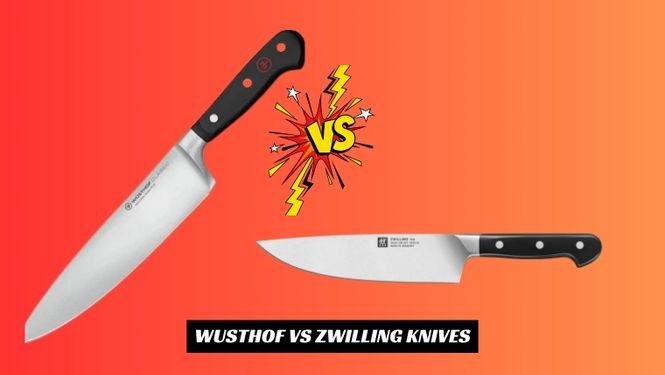
Do you want to choose between Wusthof and Zwilling knives? Especially the Wusthof Classic and Zwilling Pro. Fortunately, I used both knives in my home for twelve long years.
Wusthof Classic gives me a sharp point for neat cuts. Zwilling Pro hugs my thumb for smooth rock cuts. Both brands come from German steel shops and lead the chef knife world.
- Winner: Wusthof Classic 8-Inch Chef’s Knife.
- Best for Push Cuts and Tip Work: Wusthof Classic 8-Inch Chef’s Knife.
- Best for Pinch Grip and Rock Cuts: Zwilling Pro 8-Inch Chef’s Knife.
Wusthof Classic vs Zwilling Pro Knives
I put Wusthof Classic and Zwilling Pro through years of home tests. I also tested the Wusthof Ikon and Zwilling Pro S. I checked each knife on my scale and shop gauge. Use my charts here so you can choose easily:
Brand Story and How They Compare
| Brand Trait | Wusthof | Zwilling |
| Year Started | 1814 in Solingen, Germany | June 13, 1731 in Solingen, Germany |
| Founder | Johann Abraham Wusthof | Peter Henckels (named for son Johann) |
| First US Reach | 1881 with two cases of blades | 1883 New York City shop |
| Current Owner | 7th-term Wusthof kin (Harald & Viola) | Werhahn Group since 1970 |
| Shop Focus | 100% kitchen knives only | Knives, Staub pots, pans, and gear |
| Old-World Roots | Carbon steel and wood pins | Carbon steel and wood pins |
| Core Forged Picks | Wusthof Classic & Classic Ikon | Zwilling Pro & Zwilling Pro S |
| Flat Edge Pick | Wusthof Classic | Zwilling Pro Traditional |
- Pure Knife Winner: Wusthof Classic and Wusthof Classic Ikon. They win since one clan still runs the shop and makes only knives.
- Long Roots Winner: Zwilling Pro, Zwilling Pro Traditional, and Zwilling Pro S. They win for 1731 guild roots and a huge range of kitchen gear.
When I hold my Wusthof Classic and Zwilling Pro, I feel two old souls from Solingen, the famed City of Blades. Peter Henckels started Zwilling there in 1731, and his son Johann later gave the shop his own name. Johann Wusthof began his blade shop in 1814 down in a small stone cellar. By the 1880s, Robert Wusthof sailed to America with two cases of knives right before Zwilling opened its New York store in 1883.
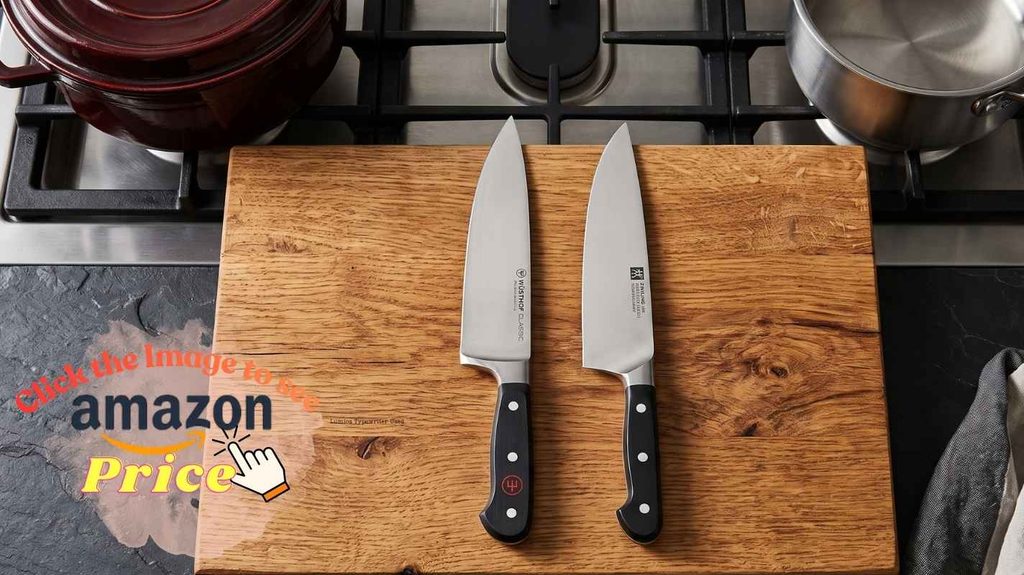
Long ago, both shops forged dark carbon steel with wood grips and pins for heavy meat prep. Later, I watched old wood grips split from sink water, which is why both brands moved to stain-free steel and black grips that never crack. Today, seventh-term kin Viola and Harald Wusthof run their shop and put all their skill into knives alone. Meanwhile, the Werhahn Group bought Zwilling in 1970 and now makes Staub pots and Demeyere pans next to its blades.
Think of Wusthof as a lone master smith and Zwilling as a big kitchen hall. In my twelve years of home prep, I love that Wusthof Classic and Wusthof Classic Ikon come from one family that only makes blades. Still, Zwilling Pro and Zwilling Pro S bring nearly three hundred years of smart tool craft to your board. Buy Wusthof Classic for pure family blade craft, or pick Zwilling Pro Traditional if you want the Zwilling Pro grip with a flat edge.
1. How They Are Made
| Build Trait | Wusthof Classic 8″ Chef | Zwilling Pro 8″ Chef |
| Manufacturing | Forged from one steel bar | SIGMAFORGE one-piece steel |
| Steps Involved | 54 factory steps | 40+ Friodur ice steps |
| Steel Chemistry | X50CrMoV15 (0.5% C, 15% Cr, Mo, V) | Special Formula Friodur steel |
| Freeze / Rust Tech | Hidden tang ring stops grip rust | -70°C (-94°F) ice bath (since 1939) |
| Spine & Taper | 2.8 mm heel, tapers to tip | 2.8 mm heel, tapers to tip |
| Expected Lifespan | Lifetime, 20+ years | Lifetime, 20+ years |
| Impact Resistance | Very High | Very High |
| Full Tang Build | Yes | Yes |
| Made Only in Germany | Yes, 100% Solingen | No, some lines in Japan/Spain |
- German Craft Winner: Wusthof Classic, Wusthof Classic Demi, and Wusthof Classic Ikon. They win for 54 steps in one German shop and a hidden ring that blocks tang rust.
- Ice Build Winner: Zwilling Pro, Zwilling Pro Traditional, and Zwilling Pro S. They win for deep -70°C ice chill steps that lock in tough grain and stop rust.
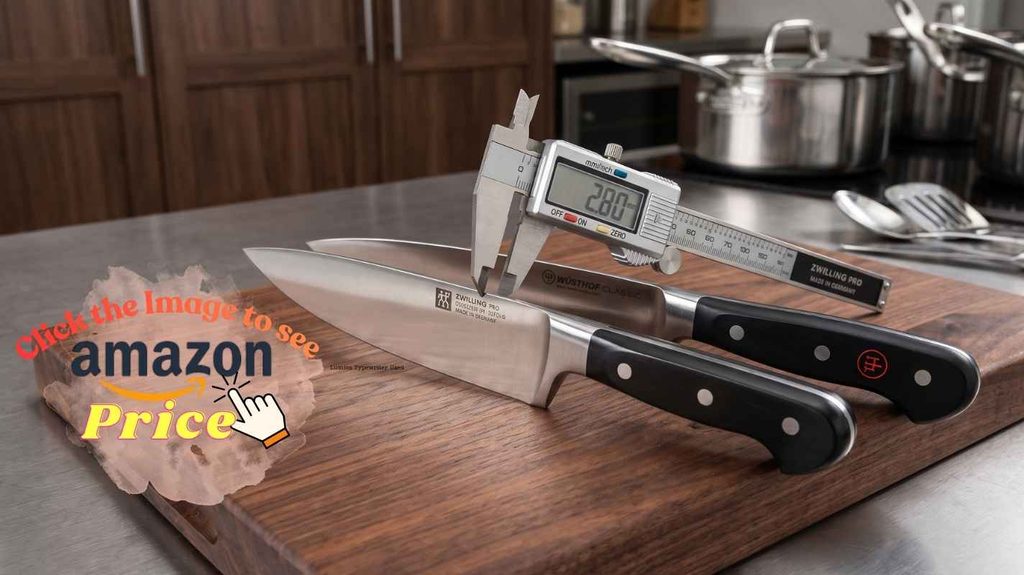
I clamped my shop gauge onto the top spine of my Wusthof Classic and Zwilling Pro side by side. Both blades start from one thick 2.8 mm steel bar that runs all the way to the butt. As you run a finger from the heel to the fine point, both blades thin out in a smooth wedge. That stiff full tang acts like a steel backbone, so neither knife ever bends on my board.
Wusthof blends rich chrome steel across 54 shop steps and hides a tiny metal ring on the tang to stop rust inside the grip. Zwilling uses its 1939 cold bath trick, plunging hot steel into a deep minus 70°C freeze. That cold shock locks the steel grain tight like winter ice so it shrugs off stains and hard hits. Both builds feel so solid that you can pass them down to your kids after twenty years of home prep.
One day a friend showed me his new Zwilling box, and we spotted “Made in Spain” stamped on his Twin Gourmet blade. Every single Wusthof knife comes straight from Solingen, while Zwilling makes Twin Fin II and Kramer in Japan and Twin Gourmet in Spain. Still, flagship models like Zwilling Pro and Zwilling Pro S are forged 100% in Germany. Pick Wusthof Classic or Wusthof Classic Ikon if you want pure German craft on every box, or grab Zwilling Pro for ice-chilled steel.
2. Blade Hardness and How Sharp It Gets
| Sharpness Trait | Wusthof Classic 8″ Chef | Zwilling Pro 8″ Chef |
| Rockwell Hardness | 58 HRC | 57 HRC |
| Edge Angle per Side | 14 degrees (28° total) | 15 degrees (30° total) |
| Sharpness from Factory | Very High, 140 BESS score | High, ~155 BESS laser-checked edge |
| Edge Grinding Tech | PEtec laser, wet stone, and buff disk | Laser-checked V-edge grind |
| Paper Slice Test | Glides with zero drag | Clean slice with slight tooth |
| Vs 66 HRC Hard Steel | Softer, bends instead of cracking | Softer, bends instead of cracking |
| Beats 15-Degree Standard | Yes | No (matches 15° standard) |
| Chipped in My Tests | No | No |
- Box Sharpness Winner: Wusthof Classic, Wusthof Classic Demi, and Wusthof Classic Ikon. They win for a keen 14-degree PEtec edge, 58 HRC steel, and a 140 BESS score on day one.
- Tough Edge Winner: Zwilling Pro, Zwilling Pro Traditional, and Zwilling Pro S. They win for a strong 15-degree bevel and forgiving 57 HRC steel.
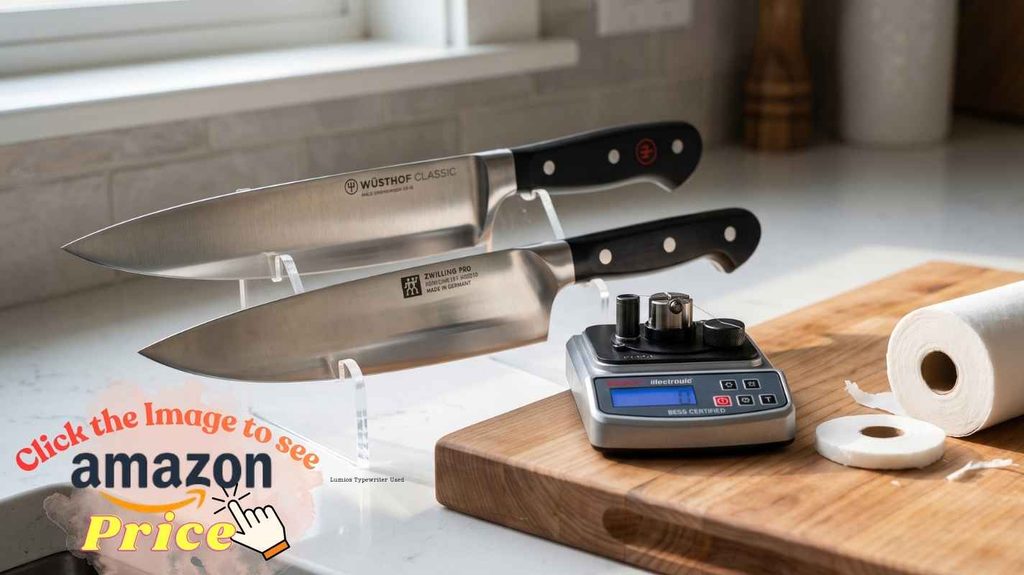
The day I unboxed both knives, I set them right on my shop BESS wire tester. Out of the box, my Wusthof Classic hit a keen 140 BESS score and slid through thin store paper like warm butter. Wusthof scans each blade with a PEtec laser to set a steep 14-degree edge per side. Then shop arms hone the steel on a wet stone and buff it clean on a disk.
My Zwilling Pro scored 155 on that same gauge, which still feels razor sharp on your first cut. Zwilling grinds its blade to 15 degrees per side for a sturdy 30-degree total V-edge. On the hardness chart, Wusthof sits at 58 HRC while Zwilling rests one step softer at 57 HRC. That tiny one-point gap is like two strong brothers where one wears a slightly thicker jacket.
In my shop, super hard 66 HRC blades can snap like thin glass if you slip or twist on the board. Since Wusthof sits at 58 HRC and Zwilling sits at 57 HRC, the edge gives just a hair instead of cracking, so neither blade ever chipped in all my tests. Buy Wusthof Classic, Wusthof Classic Demi, or Wusthof Classic Ikon if you want the sharpest bite straight from the box. Pick Zwilling Pro, Zwilling Pro Traditional, or Zwilling Pro S if you want a stout 15-degree edge that forgives rough board hits.
3. Weight and How It Feels in Your Hand
| Weight & Poise Trait | Wusthof Classic 8″ Chef | Zwilling Pro 8″ Chef |
| Flagship 8″ Weight | 9.2 oz (261 g) | 9.4 oz (266 g) on Pro & Traditional |
| Demi / Pro S Weight | ~6.5 oz (30% lighter) on Classic Demi | 8.7 oz (247 g) on Pro S |
| Classic Ikon Weight | 9.9 oz (280 g, heaviest tested) | N/A (Pro stays 9.4 oz) |
| Balance Point | Dead center at bolster | Dead center at bolster |
| Ikon Balance Point | 1 inch behind blade (rear steel cap) | Centered for pinch hold |
| Hand Fatigue (30 Min) | Very Low | Low on rock cuts |
| Balanced at Center | Yes | Yes |
| Feels Back-Heavy | No on Classic/Demi, Yes on Ikon | No |
- Center Poise & Light Winner: Wusthof Classic and Wusthof Classic Demi. They win for dead-center 9.2 oz poise and a 30% lighter 6.5 oz demi choice.
- Rock Heft & Trim Winner: Zwilling Pro, Zwilling Pro Traditional, and Zwilling Pro S. They win for solid 9.4 oz rock weight and a trim 8.7 oz Pro S choice.
- Rear Poise Winner: Wusthof Classic Ikon. It wins at 9.9 oz for cooks who love a back-heavy palm hold.
I set my digital scale on the counter to check the real heft of each eight-inch blade. My Wusthof Classic weighed 9.2 oz, while my Zwilling Pro and Zwilling Pro Traditional sat right near it at 9.4 oz. If a nine-ounce blade feels like a heavy brick after ten minutes, Zwilling Pro S drops down to a brisk 8.7 oz. Better yet, Wusthof Classic Demi trims off a full third of the weight to hit a light 6.5 oz.
Raw weight only tells half the story when you chop for a full hour on Sunday. When I rest Wusthof Classic, Zwilling Pro, or Zwilling Pro S on one finger at the neck, they sit flat like a seesaw. By contrast, my Wusthof Classic Ikon hits 9.9 oz and tips one inch behind the blade because of its rear steel cap. That tail weight pulls the poise straight back into the palm of your hand.
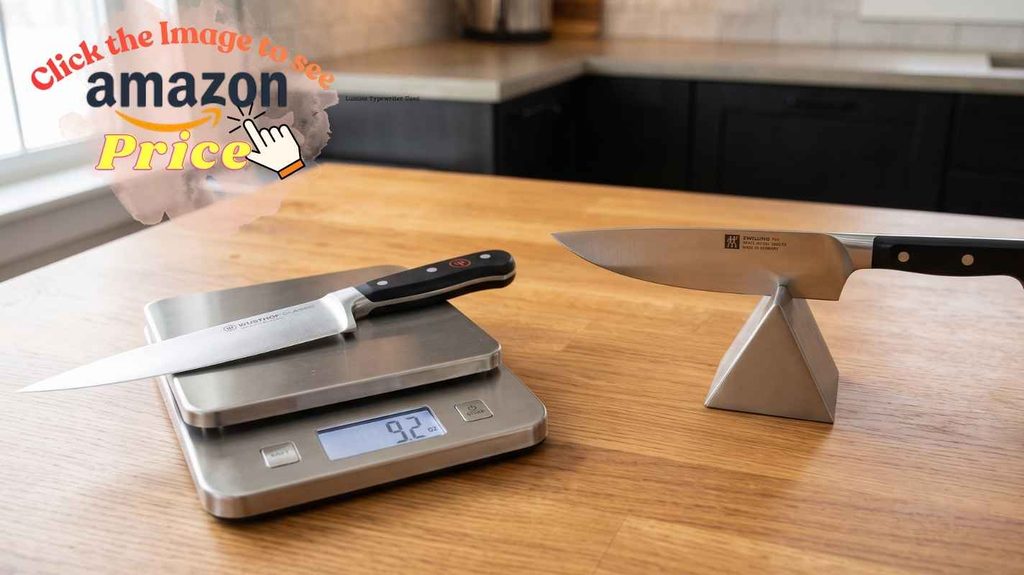
At first, I feared the heavy Wusthof Classic Ikon would tire my arm, yet that rear cap actually makes the front tip feel light and quick in the air. Meanwhile, the 9.4 oz Zwilling Pro uses its center heft to drop through food with almost no push from your wrist. Buy Wusthof Classic or Zwilling Pro for dead-center poise, or pick Wusthof Classic Demi and Zwilling Pro S if your wrist gets sore fast. If you hold the handle back in your palm, grab Wusthof Classic Ikon for its cozy rear weight.
4. The Bolster Design and Stone Care
| Bolster Trait | Wusthof Classic 8″ Chef | Zwilling Pro 8″ Chef |
| Standard Guard Type | Full guard to heel | Sloped, flared half guard (Matteo Thun design) |
| Half-Guard Option | Classic Demi & Classic Ikon | Standard on Pro & Pro Traditional |
| Full-Guard Option | Standard on Classic | Zwilling Pro S |
| Pinch Grip Feel | Slim on Demi/Ikon, rubs on Full | Wide, curved thumb rest overlaps blade |
| Heel Edge Bite | Sharp heel for nuts and ginger | Sharp heel to tip (Pro S heel is blunt) |
| Full Edge on Stone | No on Full, Yes on Demi/Ikon | Yes, sharpens tip to choil |
| Mashes Food at Heel | Can mash over years on Full | No, clean cut at heel for life |
- Pinch Guard Winner: Zwilling Pro and Zwilling Pro Traditional. They win for the wide, sloped guard that hugs your thumb and hones clean from heel to tip.
- Slim Demi & Heel Winner: Wusthof Classic Demi, Wusthof Classic Ikon, and Wusthof Classic. Demi and Ikon win for a slim half guard, while the full-guard Classic still splits hard nuts at the heel.
The steel neck between the grip and the blade shifts how your hand feels on every cut. On my Zwilling Pro and Zwilling Pro Traditional, maker Matteo Thun shaped a wide half guard that slopes right onto the blade face. When I pinch the blade base, my thumb rests on that smooth curve like a soft saddle with zero rub. If you have small hands and find that flared ramp too wide, Wusthof Classic Demi and Wusthof Classic Ikon offer a much slimmer half guard.
My full-guard Wusthof Classic and Zwilling Pro S run thick steel all the way down to the heel. Many folks think a full guard saves your fingers, yet kitchen slips almost always nick the guide hand holding the food on the board. Still, I found a fun quirk when I pressed both full guards down on hard walnuts and woody ginger. The back heel on Wusthof Classic stays sharp enough to split hard nuts, while the heel on Zwilling Pro S is left thick and blunt.
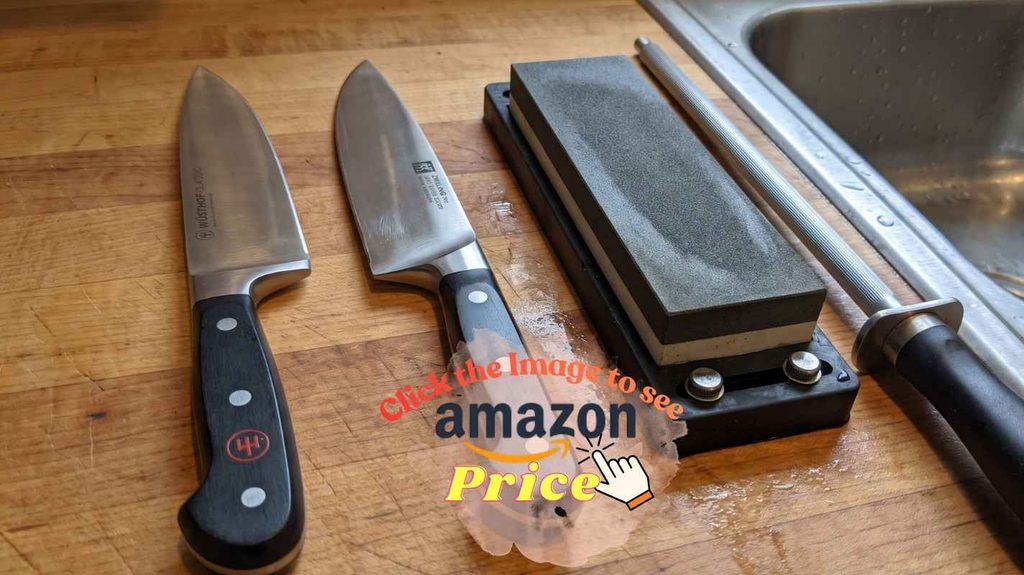
The real catch with any full guard shows up after years of home stone care. Since that thick metal neck blocks the back half inch of the blade, the edge wears up over time until the guard sticks down and mashes herbs on the board. With Zwilling Pro, Wusthof Classic Demi, and Wusthof Classic Ikon, the heel stays bare so your stone hits every bit of steel from tip to choil. Pick Zwilling Pro or Zwilling Pro Traditional for a wide thumb rest, or buy Wusthof Classic Demi for a slim pinch hold that stays flat on your stone for life.
5. Price and Real Cost Over Time
| Cost Trait | Wusthof Classic 8″ Chef | Zwilling Pro 8″ Chef |
| 8-Inch Chef Price Range | $100 to $350 across lines | $90 to $450 across lines |
| Mean / Median Price | $223 mean / $228 median | $202 mean / $160 median |
| Flagship 8″ Retail Tag | ~$170 Classic / ~$200 Classic Ikon | ~$150 to $170 on Pro, Traditional & Pro S |
| Typical Retail Gap | $10 to $30 more at retail | $10 to $30 less at retail |
| Big Sale Example | 2-knife starter sets ~20% off | Four Star 8″ drops to $59.99 |
| Cost per Year (10 Years) | ~$17 to $22 per year | ~$15 to $20 per year |
| Pro Sharpening Cost | ~$10 to $15 per blade | ~$10 to $15 per blade |
| Total 10-Year Cost (Pro Care) | ~$320 to $370 total (~$205 with DIY stone) | ~$260 to $310 total (~$195 with DIY stone) |
| 60-Day Return Window | No, 45 days on brand site | Yes, 60 days on brand site |
- Best Value & Trial Winner: Zwilling Pro, Zwilling Pro Traditional, Zwilling Pro S, and Zwilling Four Star. They win for a lower $160 mid price, $59.99 holiday sales on Four Star, and 60 trial days.
- Resale & Set Value Winner: Wusthof Classic, Wusthof Classic Demi, and Wusthof Classic Ikon. They win for steady retail value, high used resale prices, and 20%-off two-knife set deals.
I tracked the price tags of every eight-inch chef knife across both brand sites for a full year. Wusthof runs from $100 to $350 with a $223 mean and $228 mid price, where Wusthof Classic sits near $170 and Wusthof Classic Ikon hits $200. Zwilling spans $90 to $450, yet its lower $202 mean and $160 mid price leave more cash in your pocket. Side by side in most stores, you will pay $10 to $30 less for Zwilling Pro or Zwilling Pro S than for a Wusthof peer.
If you love hunting for a deal, Zwilling cuts its prices much deeper during big fall sales. I once grabbed a forged eight-inch Zwilling Four Star for a friend at just $59.99, and Zwilling gives you 60 full days to test your knife at home versus 45 days at Wusthof. Wusthof rarely puts single blades on deep sale, so their best deal hides inside two-knife chef and paring sets at 20% off. Skip the huge thousand-dollar wood blocks from both brands, since two core knives handle almost every meal on your board.
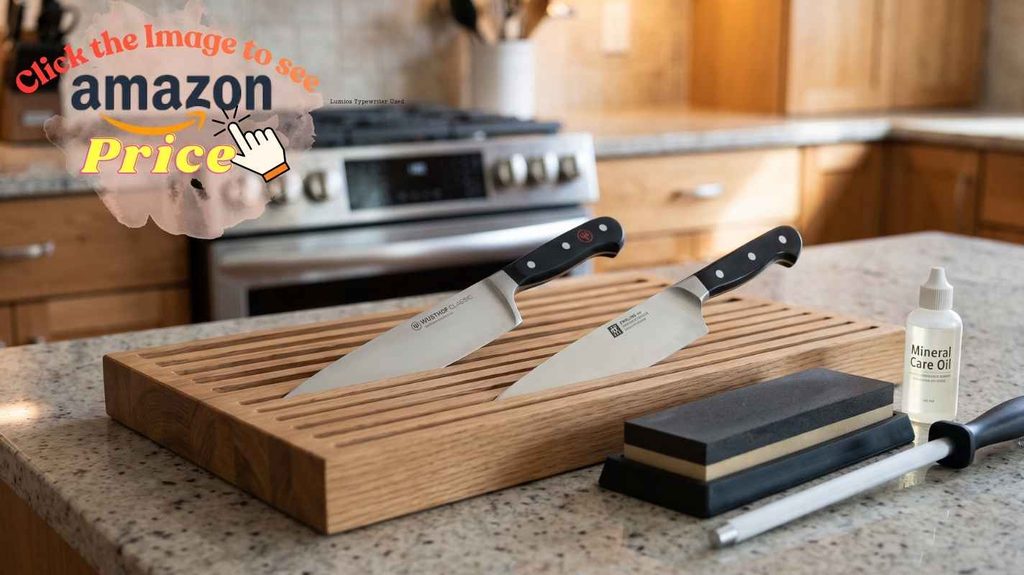
Over ten years, your real cost comes down to how you care for the edge. Paying a pro shop $10 to $15 a year brings your ten-year total to $260 to $310 for Zwilling and $320 to $370 for Wusthof, while one $35 home stone cuts that care bill to pennies a week. Because Wusthof rarely slashes its store tags, Wusthof Classic and Wusthof Classic Ikon hold much higher resale value if you ever sell your tools. Pick Zwilling Pro, Zwilling Pro Traditional, or Zwilling Four Star to save money upfront with a 60-day trial, or buy Wusthof Classic and Wusthof Classic Demi in a two-knife set for lasting value.
6. Hand Comfort and How the Handle Feels
| Handle Trait | Wusthof Classic 8″ Chef | Zwilling Pro 8″ Chef |
| Handle Material | Black POM resin | Black POM resin |
| Side-to-Side Width | Slim 16.7 mm (Ikon is 20 mm) | Wider 19.0 mm (Pro, Traditional & Pro S) |
| Top-to-Bottom Height | Tall 28 to 29 mm | Compact 25.0 mm |
| Handle Grip Feel | Slim, flat sides, nimble rudder feel | Broad, soft-rounded full palm feel |
| Spine & Corner Finish | Crisp spine, flat side cheeks | Softly rounded spine and neck edges |
| Butt End Hook | Curved pinky stop (steel cap on Ikon) | Curved pinky stop |
| Visible Triple Rivets | Yes, flush stainless steel | Yes, flush stainless steel |
| Grip Security When Wet | High | High |
| Fits Pinch Grip Best | Yes on Classic & Demi, No on Ikon | Yes, top pinch hold |
- Slim Grip Winner: Wusthof Classic and Wusthof Classic Demi. They win for a narrow 16.7 mm width and tall 29 mm height that feel fast, trim, and twist-free in your hand.
- Wide Pinch Winner: Zwilling Pro, Zwilling Pro Traditional, and Zwilling Pro S. They win for a rounded 19 mm width, compact 25 mm height, and smooth spine that lock in a cozy pinch hold.
- Palm Grip Winner: Wusthof Classic Ikon. It wins at 20 mm wide by 29 mm tall for cooks who wrap all four fingers around the full handle.
At first glance, the black POM grips on Wusthof Classic, Zwilling Pro, and Zwilling Pro S look like twin brothers. Yet when I clamped each grip in my shop gauge, I found real size gaps that your palm feels right away. Zwilling Pro, Zwilling Pro Traditional, and Zwilling Pro S all span a broad 19 mm wide and a compact 25 mm tall. By contrast, Wusthof Classic and Wusthof Classic Demi are much slimmer at 16.7 mm wide, yet stand so tall at 28 to 29 mm that they barely fit my gauge!
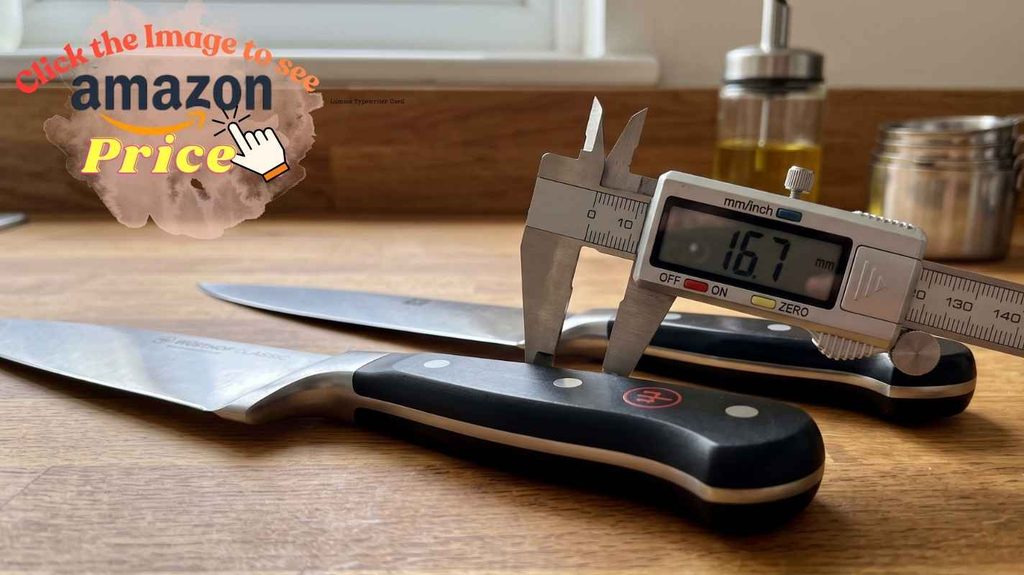
Those numbers explain why each blade feels so different when your fingers get slick with olive oil. The flat, tall 16.7 mm sides on Wusthof Classic act like a thin boat rudder, so the blade never twists in wet hands. Meanwhile, the rounder 19 mm sides and soft spine on Zwilling Pro fill out a medium or large palm with zero sharp edges. Over on Wusthof Classic Ikon, its curvy coke-bottle shape swells out to a stout 20 mm wide by 29 mm tall.
In my long prep tests, that round swell on Wusthof Classic Ikon feels like a warm handshake when you hold the back handle. Still, skip the Ikon if you pinch the blade base, since its narrow front dip and wide middle push odd against a forward grip. Buy Wusthof Classic or Wusthof Classic Demi if you want my favorite slim 16.7 mm feel that never feels fat in your fingers. Pick Zwilling Pro, Zwilling Pro Traditional, or Zwilling Pro S for a wider 19 mm pinch grip, or grab Wusthof Classic Ikon for a comfy rear palm hold.
7. How Long the Edge Stays Sharp
| Edge Life Trait | Wusthof Classic 8″ Chef | Zwilling Pro 8″ Chef |
| Lab Claim vs Real Life | Claims 20–30% longer; ties at home | Ties Wusthof in daily board prep |
| Days Until Dull | ~30 to 45 days without rod | ~30 to 45 days without rod |
| Honing Rod Use | 2 to 3 times per week (5 swipes) | 2 to 3 times per week (5 swipes) |
| Stone Care Gap | Every 6 to 12 months | Every 6 to 12 months |
| Best Stone Grit | 1000 grit to set, 3000 grit to buff | 1000 grit to set, 3000 grit to buff |
| DIY Stone Time | Fast, 10 min on flatter profile | Slow, 15 min on deep front belly |
| If You Skip Care | Rolls smoothly, zero chips | Rolls smoothly, zero chips |
| Rod & Strop Snap | Very High, snaps right back | Very High, snaps right back |
| Easy Flat Stone Pass | Yes on Demi & Ikon | No on Pro, Yes on Traditional |
- Stone Care Winner: Wusthof Classic Demi, Wusthof Classic Ikon, and Zwilling Pro Traditional. They win for a flatter blade curve and bare heel that glide across a wet stone in ten minutes.
- Rod Snap Winner: Tie for Wusthof Classic, Wusthof Classic Demi, Wusthof Classic Ikon, Zwilling Pro, Zwilling Pro Traditional, and Zwilling Pro S. All six snap right back to life with five swipes on a honing rod.
On paper, Wusthof claims its laser edge lasts up to a third longer than rival steel. Yet when I use my Wusthof Classic and Zwilling Pro side by side for home meals, I feel no real gap on the board. If you skip all care, both blades start to slip on slick tomato skin after 30 to 45 days. Still, five quick swipes on a honing rod two or three times a week keep both knives keen for six to twelve months.
Think of a German knife edge like a blade of green grass under your shoe. Each time it hits your board, the microscopic steel tip bends slightly to the side instead of breaking off. Because neither blade chips, a steel rod or leather strop stands that bent edge right back up in ten seconds flat. That quick bounce is why I trust both Wusthof Classic and Zwilling Pro S on busy weeknights.
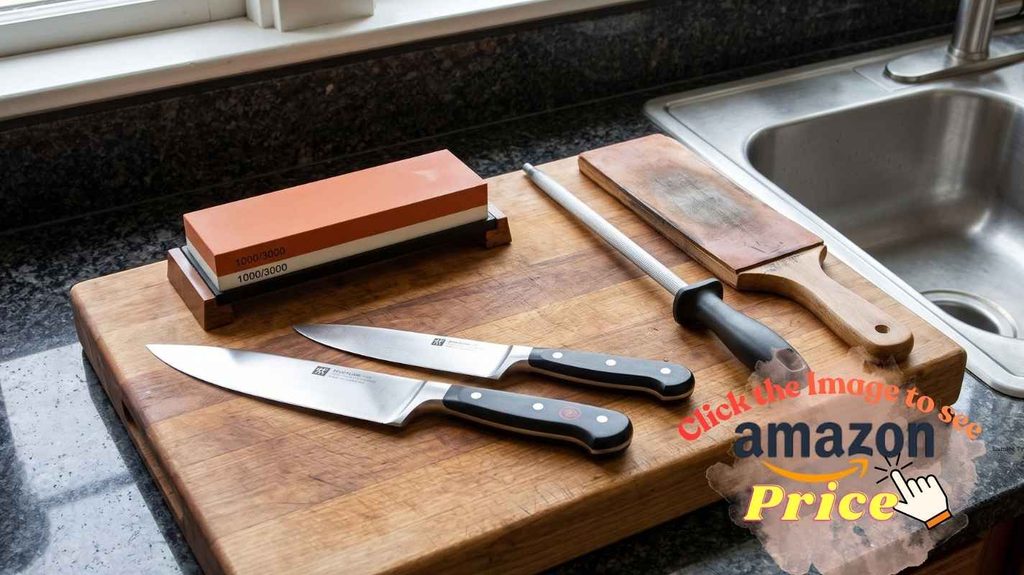
The real split shows up twice a year when I pull out my $35 1000-grit waterstone. Because the standard Zwilling Pro has a deep front belly curve, you must lift your elbow high on each stroke to reach the tip, which takes 15 careful minutes. On Wusthof Classic Demi, Wusthof Classic Ikon, or Zwilling Pro Traditional, the gentler curve glides across a flat stone in just 10 easy minutes. Buy Wusthof Classic Demi, Wusthof Classic Ikon, or Zwilling Pro Traditional if you sharpen on flat stones at home, or pick standard Wusthof Classic and Zwilling Pro if you rely on a honing rod.
8. Kitchen Performance on Veggies, Herbs, and Fruit
| Veggie & Herb Task | Wusthof Classic 8″ Chef | Zwilling Pro 8″ Chef |
| Tip Position | Low, centered drop point | High, spine-aligned tip (low on Traditional & Pro S) |
| Slicing Ripe Tomatoes | Very High, instant skin bite | High, clean skin slice |
| Dicing Onions (Tip Slits) | Very High, low centered tip | Low on Pro, High on Traditional & Pro S |
| Dense Carrots & Apples | Glides with low wedging force | Clean split with sturdy push |
| Chopping Hard Squash | Very High, zero blade twist | Very High, strong flat heel |
| Rock Chopping Herbs | High, smooth full rock | Very High at round front curve |
| Tap Chopping Garlic | Yes, low natural wrist angle | No on 8″ Pro, lifts arm 10 inches |
| Smooth Heel-to-Tip Rock | Yes, gradual curve heel to tip | No, flat rear edge stops rock short |
- Tip Work & All-Around Veggie Winner: Wusthof Classic, Wusthof Classic Demi, Wusthof Classic Ikon, Zwilling Pro Traditional, and Zwilling Pro S. They win for a low centered point, easy onion slits, and smooth heel-to-tip rocking.
- Front Herb Rock Winner: Zwilling Pro. It wins for a round front belly that rocks through tall herb piles and a flat back edge for straight down chops.
Blade shape gives you the biggest shock the first time you prep dinner on your board. On my Wusthof Classic, Wusthof Classic Ikon, Zwilling Pro S, and Zwilling Pro Traditional, the top spine curves down to set the tip near the middle. When I slit a sweet onion, core a ripe tomato, or tap chop soft garlic, that low point keeps my wrist flat and safe. Even better, Wusthof’s keen edge bites into slick tomato skin and crisp apples with almost zero downward push.
The standard Zwilling Pro takes a very different path with a straight spine and a deep front belly that pushes the tip way up high. That round front curve rocks through tall piles of cilantro and basil like a boat riding smooth waves. Yet when I tried to tap chop small shallots with the tip of my eight-inch Zwilling Pro, I had to lift my arm ten inches into the air! Cocking your elbow up that high feels odd and tires your shoulder during fine tip work.
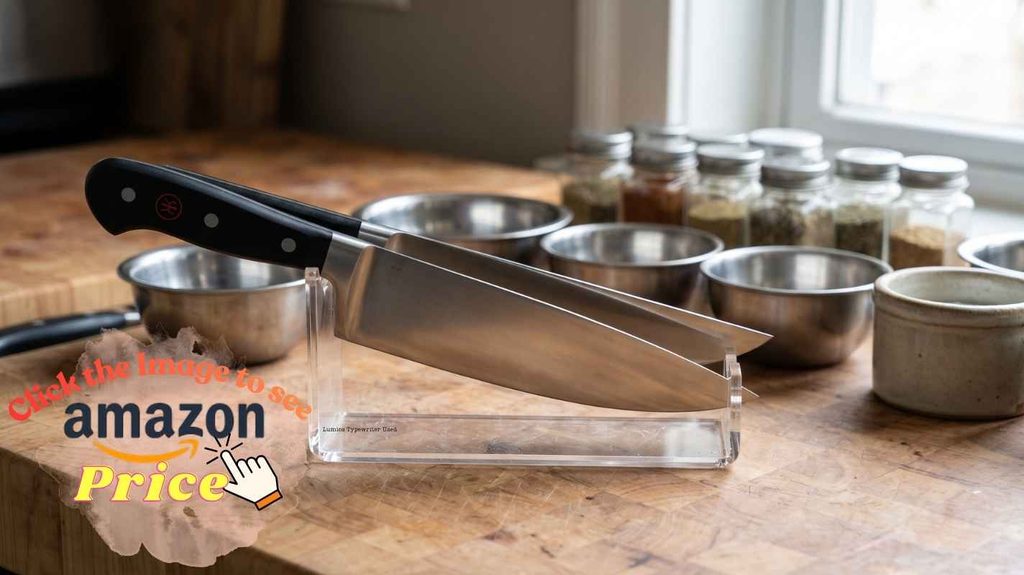
If you look at the back half of Zwilling Pro, you will spot a dead-flat edge that slams straight down through hard squash and thick celery. The catch is that when you rock all the way back from tip to heel, that flat rear edge hits the board with a sudden stop instead of a smooth roll. Buy Wusthof Classic, Wusthof Classic Demi, Wusthof Classic Ikon, or Zwilling Pro Traditional if you want a low point for easy onion dicing, push cuts, and smooth full-blade rocking. Pick the standard Zwilling Pro if you love rocking green herbs on the front belly and slamming through root veggies at the flat heel.
9. Kitchen Performance on Meat, Fish, and Tough Tasks
| Meat & Tough Prep Task | Wusthof Classic 8″ Chef | Zwilling Pro 8″ Chef |
| Carving Cooked Chicken | Very High, nimble point | Very High, sturdy heft |
| Trimming Silver Skin | Very High, narrow tip slips under | Moderate on Pro, High on Traditional & Pro S |
| Slicing Raw Fish | High, clean pull slice | High, clean pull slice |
| Hollow Edge Option | Yes on Classic & Classic Ikon Hollow Edge | Yes on Pro Hollow Edge & Rocking Santoku |
| Parting Whole Poultry | Yes, shrugs off wing and thigh joints | Yes, shrugs off wing and thigh joints |
| Twisting Avocado Pits | Yes, zero edge roll | Yes, zero edge roll |
| Smashing Garlic Flat | High, sturdy spine side | Very High, wide front paddle face |
| Left- & Right-Handed | Yes, 50/50 even bevel | Yes, 50/50 even bevel |
| Safe on Beef Bones | No, use a meat cleaver | No, use a meat cleaver |
| Safe on Frozen Food | No, can warp fine edge | No, can warp fine edge |
- Meat & Joint Tie Winner: Wusthof Classic, Wusthof Classic Demi, Wusthof Classic Ikon, Zwilling Pro, Zwilling Pro Traditional, and Zwilling Pro S. All six power through poultry joints and hard avocado pits with zero chips or edge rolls.
- Silver Skin & Tight Joint Winner: Wusthof Classic, Wusthof Classic Demi, Wusthof Classic Ikon, Zwilling Pro Traditional, and Zwilling Pro S. They win for a narrower tip that slips under meat membrane and around small bones.
When I part whole chickens or trim a Sunday beef roast, both Wusthof Classic and Zwilling Pro work like iron tanks. You can pop right through poultry rib joints, whack a hard avocado pit, and twist it clean out with zero dents on the edge. Both shops also grind a dead-even 50/50 bevel on each side of the blade. That balanced grind lets left-handed and right-handed cooks pull straight, clean slices through raw fish or warm steak without the blade drifting sideways.
Still, I felt one real split when I trimmed tough silver skin off a beef tenderloin. The low, narrower tip on Wusthof Classic, Wusthof Classic Ikon, and Zwilling Pro S slips under thin meat skin and into tight thigh joints much easier than the tall front belly on Zwilling Pro. On the flip side, that wide front face on Zwilling Pro works like a broad steel paddle to smash garlic cloves flat in one slap. If wet raw chicken or fatty fish sticks to your blade, both brands sell hollow-edge models with small air dimples to help food slide off.
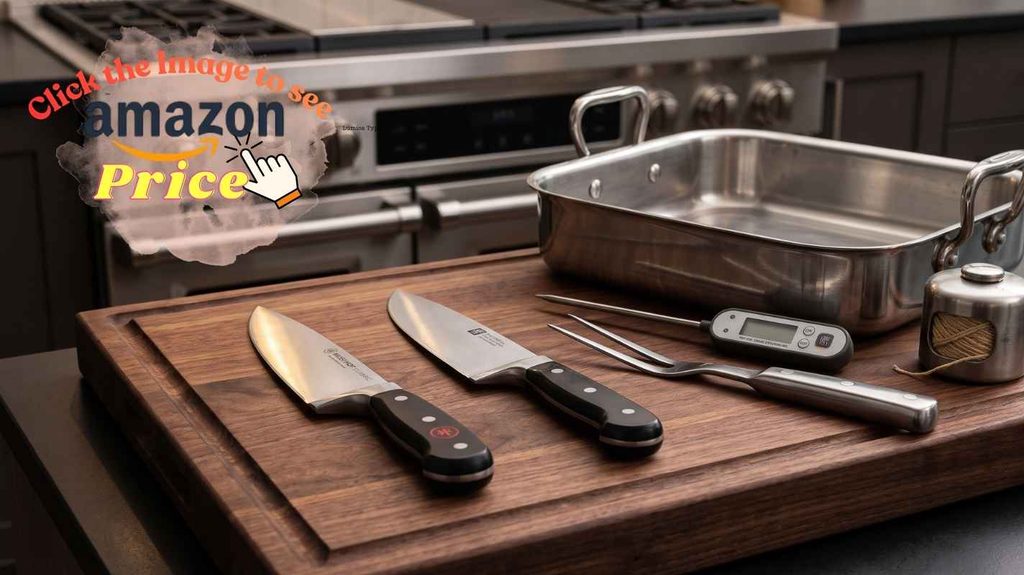
Even though these forged German blades are super tough, remember that they are chef knives and not heavy butcher cleavers. Keep both knives away from thick beef marrow bones and rock-hard frozen food blocks so you never warp the fine edge. Buy Wusthof Classic, Wusthof Classic Demi, Wusthof Classic Ikon, or Zwilling Pro S if you do lots of fine meat trimming and tight bone work with the point. Pick Zwilling Pro or Zwilling Pro Traditional if you want a wide, hefty blade for carving thick roasts and crushing garlic on the board.
10. Brand Lineup, Logo Check, and US Buyer Protection
| Brand & Lineup Trait | Wusthof | Zwilling |
| Total Knife Series | 9 focused knife series | 18 broad knife series |
| Entry Stamped Line | Wusthof Gourmet | Zwilling Gourmet (plus molded Four Star) |
| Mid-Tier Forged Lines | Classic, Classic Demi, Classic Ikon | Pro, Pro Traditional, Pro S |
| Premium Upgrade Lines | Amici (olive wood), Ikon Blackwood, Performer (black DLC coat) | Kramer, Tanrei (63 HRC), Spectrum (blue micarta) |
| Color Handle Options | Wide Classic Color & Classic Ikon Crème | Pro Le Blanc white, Spectrum blue & Now S |
| Confusing Sub-Brand Logo | No, all 9 lines carry 3-point Trident logo | Yes, look for 2-man Twins; skip 1-man Henckels |
| Lifetime US Warranty | Yes, Norwalk, CT US hub | Yes, Pleasantville, NY US hub |
- Clear Brand & Color Winner: Wusthof Classic, Wusthof Classic Demi, Wusthof Classic Ikon, and Wusthof Gourmet. They win for zero logo traps across all nine lines and bright handle colors.
- Custom Style & Hybrid Steel Winner: Zwilling Pro, Zwilling Pro Traditional, Zwilling Pro S, Zwilling Four Star, Bob Kramer, and Zwilling Tanrei. They win for 18 diverse series reaching up to 63 HRC steel.
Here is the number one trap I warn my friends about before they buy a knife at a big department store. Real German blades like Zwilling Pro, Zwilling Pro S, and Zwilling Four Star always stamp the two-man Twins mark on the steel. If you spot only one little man holding a spear, set that box down because it is the cheap Henckels budget line made in China or Spain. Over at Wusthof, every blade across all nine lines wears the same three-point Trident mark with zero confusing sub-brands.
Once you know the logos, both makers give you fun ways to dress up your counter. Wusthof keeps its menu focused with nine lines, stepping up from stamped Gourmet to olive-wood Amici, dark Blackwood Ikon, and black diamond-coated Performer. You can also grab Wusthof Classic in fun shades like Wild Blueberry or pick Classic Ikon Crème for a soft white handle. Zwilling stretches across 18 series, offering white Pro Le Blanc, ocean-blue Spectrum micarta, and 63 HRC Tanrei and Bob Kramer blades.
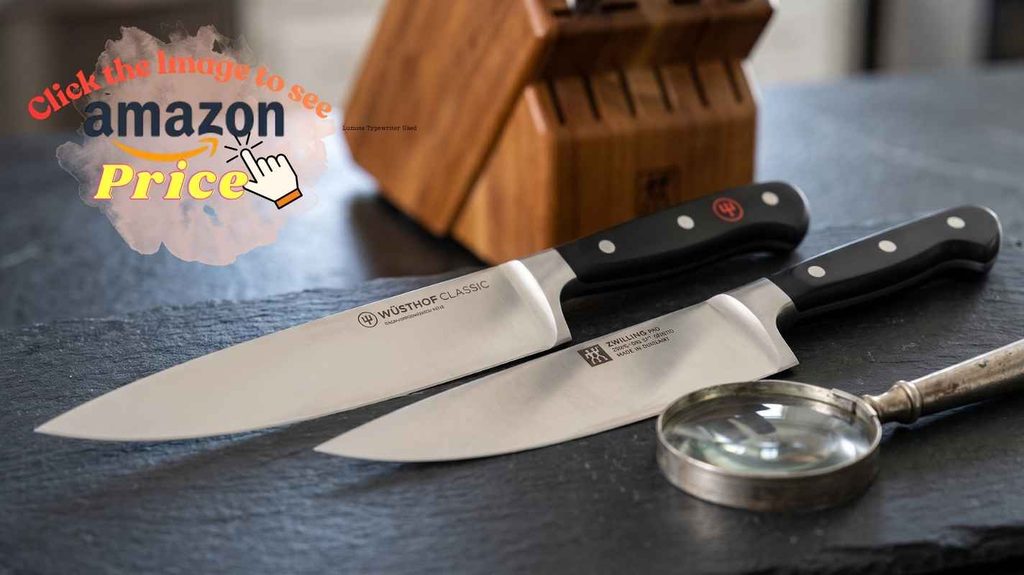
If a rare factory flaw ever shows up, both brands take care of US buyers right from the East Coast. Wusthof runs its US service hub in Norwalk, Connecticut, while Zwilling backs its lifetime warranty out of Pleasantville, New York. Buy Wusthof Classic, Wusthof Classic Demi, or Wusthof Classic Ikon if you want a simple nine-line roster, fun grip shades, and zero logo guesswork. Pick Zwilling Pro, Zwilling Pro Traditional, or Zwilling Tanrei if you check for the two-man Twins mark and want 18 custom styles to explore.
11. Daily Care, Board Rules, and Storage
| Care & Storage Trait | Wusthof Classic 8″ Chef | Zwilling Pro 8″ Chef |
| Dishwasher Safe | No, hand wash and dry right away | No, hand wash and dry right away |
| Best Cutting Boards | Maple, walnut, cherry, and oak | Maple, walnut, cherry, and oak |
| Safe on Hard Oak Boards | Yes, tested on my oak board | Yes, tested on my oak board |
| Boards to Avoid | Bamboo, teak, glass, stone, hard plastic | Bamboo, teak, glass, stone, hard plastic |
| POM Handle Care | 1 drop of mineral oil buffs scuffs | 1 drop of mineral oil adds deep shine |
| Wood Handle Care | Oil Blackwood & Amici 2x per year | Oil Kramer wood grips 2x per year |
| Handle Badge Wear | Old red tag faded; new badge is permanent | Metal and laser badge stays crisp |
| Best Storage | Wood magnet bar, drawer block, or guard | Wood magnet bar, drawer block, or guard |
- Daily Care Tie Winner: Wusthof Classic, Wusthof Classic Demi, Wusthof Classic Ikon, Zwilling Pro, Zwilling Pro Traditional, and Zwilling Pro S. All six use water-tight black POM grips that shrug off kitchen spills and shine like new with one drop of oil.
In my home shop, I use both my Wusthof Classic and Zwilling Pro right on my hard oak, maple, and walnut boards. While thin East blades can micro-chip on hard oak, these tough German knives handle wood grain with ease. Still, I always warn friends to skip bamboo and teak boards because both contain natural grit that dulls a keen edge like sandpaper. Never chop on glass or stone, and keep every forged knife out of the dishwasher so hot jets and harsh soap never pit the steel.
After twelve years of sink washes, the old red sticker on my first Wusthof Classic slowly wore off. Thankfully, Wusthof now seals that Trident mark permanently into Wusthof Classic, Wusthof Classic Demi, and Wusthof Classic Ikon, matching the crisp metal Twins badge on Zwilling Pro. When my old black POM grips started to look dull from years of scuffs, I rubbed one drop of food-safe mineral oil onto the scales. That single drop made my Zwilling Pro and Wusthof Classic glow like new, while wood-grip lines like Amici, Blackwood, and Kramer only need oil twice a year.
Once you wash your blade by hand and towel it dry, never toss it loose into a drawer where metal spoons can dent the edge. I keep my knives on a wood magnet strip and roll the spine off first, or tuck them into a slotted drawer block. Because both shops seal their black POM handles tight against moisture, Wusthof Classic, Wusthof Classic Ikon, Zwilling Pro, and Zwilling Pro S tie across the board for easy upkeep. Pick the grip shape your hand loves most, give it a quick hand wash after each meal, and it will stay spotless for life.
12. 8-Inch vs 10-Inch Size and Best Model by Grip Style
| Size & Grip Trait | Wusthof Classic / Ikon | Zwilling Pro / Pro Traditional |
| Best 8-Inch Home Pick | Wusthof Classic Demi 8″ | Zwilling Pro Traditional 8″ |
| 10-Inch Edge Gain | Longer reach for big melons & roasts | Fixes 8″ curve with 2/3 flat edge |
| Heel Height (Knuckle Space) | High (~1.9″ on 8″, ~2.2″ on 10″) | High (~1.9″ on 8″, ~2.2″ on 10″) |
| Compact Small-Hand Pick | Wusthof Classic 6″ or 7″ Chef | Zwilling Pro 7″ Slim Chef |
| Best for Pinch Hold | Wusthof Classic & Classic Demi | Zwilling Pro & Pro Traditional |
| Best for Palm Hold | Wusthof Classic Ikon | Zwilling Pro S |
| Best Board Size | 15×10″ for 8″ blade; 18×12″+ for 10″ | 15×10″ for 8″ blade; 18×12″+ for 10″ |
- 8-Inch Home Winner: Wusthof Classic Demi 8-Inch and Zwilling Pro Traditional 8-Inch. They win for pairing a bare, stone-friendly heel with a low tip in an easy 8-inch size.
- 10-Inch Prep Winner: Zwilling Pro 10-Inch and Wusthof Classic 10-Inch. They win for two-thirds flat board reach, tall 2.2-inch knuckle space, and one-stroke slicing on huge melons or roasts.
- Palm & Classic Grip Winner: Wusthof Classic Ikon 8-Inch, Wusthof Classic 8-Inch, and Zwilling Pro S 8-Inch. Ikon wins for a rear palm hold, while Classic and Pro S win for traditional full-guard fans.
Way back when I set up my shop, the very first blades I bought were the 10-inch Zwilling Pro and 10-inch Wusthof Classic. If you love the wide thumb ramp on Zwilling Pro yet wish it had more flat edge for push cuts, the 10-inch size solves that right away. Those extra two inches stretch out the rear section so two-thirds of the blade sits flat on the board while keeping the front rock curve. Plus, a 10-inch blade stands 2.2 inches tall at the heel for huge knuckle room and halves whole watermelons in one pass, provided you have a wide 18-inch board.
For nine out of ten home kitchens, an 8-inch chef knife is the sweet spot because it fits small counters and still gives your knuckles nearly two inches of board space. Both brands also make 6-inch and 7-inch Slim knives, though those lower heels can let your fingers tap the board during fast prep. When choosing an 8-inch model, the real secret is matching the handle and neck to how your hand naturally holds a blade. Two cooks in the very same house can pick different winners just based on whether they pinch the steel or grip the handle.
If you use a front pinch hold and want a low point with a bare heel, buy the 8-inch Wusthof Classic Demi or the flat-edge Zwilling Pro Traditional. Pinch-grip cooks who want a wider thumb ramp for herb rocking should grab the standard 8-inch Zwilling Pro, while full-guard fans will love the 8-inch Wusthof Classic. If you wrap all four fingers around the grip in a palm hold, pick Wusthof Classic Ikon for its contoured swell or Zwilling Pro S for a lighter classic feel. Finally, if you have big hands and a wide butcher block, step right up to the 10-inch Zwilling Pro or 10-inch Wusthof Classic.
13. How Wusthof and Zwilling Compare to Shun and Miyabi
| Rivalry Trait | Wusthof Classic / Zwilling Pro | Shun Classic / Miyabi | Stamped Swiss Knives |
|---|---|---|---|
| Origin & Style | Solingen, Germany (Workhorse) | Seki, Japan (Thin laser slicer) | Swiss Stamped (Light budget prep) |
| Spine & Weight | 2.8 mm spine / 8.7 to 9.9 oz | ~1.8 to 2.0 mm spine / 6.0 to 7.5 oz | ~2.0 mm spine / 4.5 to 5.5 oz |
| Steel Hardness | 57 to 58 HRC | 60 to 66 HRC | ~55 to 56 HRC |
| Edge Angle per Side | 14 to 15 degrees | 9 to 16 degrees | ~15 to 20 degrees |
| Chip & Twist Safety | Very High, takes rough use | Low, chips on hard pits or bones | High, bends under heavy load |
| Best Kitchen Role | 1-knife daily tank for all food | Boneless fish, herbs, thin veggies | Low-cost starter or camp knife |
| Typical Price | \$150 to \$228 | \$180 to \$350+ | \$45 to \$65 |
- Tough Workhorse Winner: Wusthof Classic, Wusthof Classic Demi, Wusthof Classic Ikon, Zwilling Pro, Zwilling Pro Traditional, and Zwilling Pro S. They win for forged 2.8 mm heft that powers through hard squash, joints, and pits with zero chips.
- Thin Slice Winner: Miyabi and Shun Classic. They win for thin 60 to 66 HRC blades and steep 9 to 16 degree edges on boneless fish and soft greens.
- Budget Starter Winner: Stamped Swiss Knives. They win at $45 to $65 for light, no-frills prep when cash is tight.
Friends often ask me if they should skip German steel and buy an East blade like Shun Classic or Miyabi, which Zwilling actually owns and makes in Seki, Japan. Think of Shun and Miyabi like low race cars, with thin 2 mm spines, steep 9 to 16 degree edges, and hard 60 to 66 HRC steel that whispers through raw fish and soft greens. The catch is that if you twist that hard, thin edge inside a winter squash or hit a chicken bone, the steel can chip right on the spot. By contrast, Wusthof Classic and Zwilling Pro act like tough steel trucks with 2.8 mm spines that power through squash, pits, and bird joints with zero fear.
On the budget end of my test block, a stamped Swiss knife costs just $45 to $65 and weighs a light 5 oz. Because its thin stamped blade sits at a soft 55 to 56 HRC, it will never crack, yet the steel flexes when you push through dense root veggies. You also give up the dead-center poise, smooth bolster neck, and lifetime feel of one-piece forged steel. Next to the steady heft of Wusthof Classic Ikon or Zwilling Pro S, a stamped plastic-grip blade feels more like a temporary loaner tool.
If you want one main chef knife to handle every single job on your board for the next twenty years, stick with forged German steel. Buy Wusthof Classic, Wusthof Classic Demi, or Wusthof Classic Ikon if you want a keen 14-degree German workhorse with a low point for all-around prep. Pick Zwilling Pro, Zwilling Pro Traditional, or Zwilling Pro S if you want a comfy wide pinch guard that shrugs off rough daily cooking. Down the road, you can always add one thin Miyabi or Shun blade just for boneless fish and paper-thin veggie slices.
My Cutting Experience with Wusthof and Zwilling Knives
I keep four hundred knives in my shop right now. Yet Zwilling Pro was the first chef knife I bought for my own home. Soon, I won a chef contest and got my Wusthof Classic. Those two blades sparked my deep love for fine steel.
A good knife should feel like a strong friend in your hand. Next, I put Wusthof Classic Ikon and Zwilling Pro S in my test block. In my prep tests, Zwilling Pro felt best for cooks who love a pinch hold and rock chop. Skip Zwilling Pro if you do not like a round blade curve.
When I want fast push cuts, I grab Wusthof Classic right away. Its straight spine and low point guide my hand with zero strain. It is best for cooks who want neat slits and straight chops. Skip the full guard on Wusthof Classic if a thick neck rubs your finger.
What I Like
- Tough steel: Wusthof Classic and Zwilling Pro cut hard squash. They do not chip.
- Soft thumb grip: The Zwilling Pro sloped guard feels great in a pinch hold.
- Low blade tip: The Wusthof Classic low point saves your wrist on small cuts.
- Sharp box edge: Wusthof Classic cuts at a keen 14 degrees right out of the box.
- Fair sale tags: Zwilling chef knives cost less on sale with a 60-day trial.
- Smart twin picks: Wusthof Classic Demi and the flat-edge Pro give you the best of both lines.
What Could Be Better
- Thick heel guard: The Wusthof Classic full guard blocks the heel on a stone.
- High tip angle: The 8-inch Zwilling Pro high point makes small cuts feel odd.
- Back weight: The 9.9-ounce Wusthof Classic Ikon tips back to its steel cap.
- Hard stone curve: The deep curve on Zwilling Pro is tough to hone on a flat stone.
- Dull Pro S heel: The full guard on Zwilling Pro S leaves the back heel blunt.
Frequently Asked Questions (FAQ)
Is Wusthof worth it when buying wusthof vs zwilling knives?
Yes, Wusthof is worth it. You get a sharp 14-degree edge and a low tip that saves your wrist on long prep days. Learn more about my 12-year test in our full blade guide above.
Is Zwilling Pro better than Wusthof Classic for home cooks?
Yes, Zwilling Pro is best if you use a pinch grip. Its round blade rocks through green herbs on your board with ease. Learn more about how both grips feel in our chart above.
Which stays sharp longer in the wusthof vs zwilling knives test?
Wusthof sits at 58 HRC and Zwilling sits at 57 HRC. In my kitchen tests, both hold a keen edge for six full months. Learn more about honing times in our edge care chart above.
Are all wusthof vs zwilling knives made in Germany?
Every Wusthof blade comes from their German shop. Zwilling makes its top lines there too, plus some in Spain and Japan. Learn more about factory steps in our build chart above.
How do I spot real Zwilling Pro vs cheap Henckels blades?
Look for the two-man Zwilling mark on forged steel. Skip the one-man stamp found on cheap, soft store knives. Learn more about ten-year US value in our price chart above.

Leave a Reply